
Litchfield, CT · Litchfield County · Since 1994
Mold Remediation in Litchfield, CT.
Inspection, containment, removal, prevention. We don’t just kill what you can see – we find the moisture source, stop it, then certify clean with a post-treatment clearance test. Litchfield basements are a mold-friendly environment by default. Porous fieldstone-rubble cellar walls under pre-1850 Borough homes, dirt-floor sections in 19th-century farmhouse cellars, and summer humidity that lingers longer at hill-town elevation than in inland river valleys. Remediation that ignores the source just buys you 18 months.
Free Litchfield inspection with moisture mapping. Written remediation plan within 24 hours. Post-treatment clearance test included on every job.
- Source-first remediation
- Post-treatment clearance test
- Lifetime water-source warranty
Three Litchfield-specific reasons mold calls come in
Pick the situation that fits.
Mold remediation calls in Litchfield cluster into three patterns. The diagnostic starts the same on each one – find the moisture source, contain the visible growth, remove safely, and certify clean – but the timeline depends on whether you’re dealing with a pre-1850 stone cellar, a 19th-century farmhouse addition, or a mid-century rural ranch.
Inspector flagged mold during home sale
The buyer’s inspection report flagged suspected microbial growth. You have 14 to 30 days to remediate before the deal falls apart or the price drops. We have handled hundreds of these along the Litchfield County corridor – fast, certified, with paperwork the lender’s underwriter accepts. Common on pre-1850 Borough homes and on outer rural farmhouses where the inspector caught moisture the seller had been managing quietly through the long Litchfield summer.
Get a Free InspectionVisible growth on walls, ceiling, or stored items
Black, green, or white blooms on drywall, joists, insulation, or stored boxes. You can see it and probably smell it. Cleaning with bleach will not fix it – the moisture that feeds the mold is still there, and on a porous fieldstone-rubble cellar wall it is moving through the masonry continuously. Source-first remediation paired with dehumidification is the only sequence that holds in a Litchfield basement.
Get a Free InspectionRecurring respiratory symptoms at home
Family members coughing, headaches, allergies that ease when away from home. Mold-induced symptoms from chronic low-level exposure are real and often subtle. With Litchfield’s long humid summer-to-fall transition and the porous-masonry character of the pre-1850 housing stock, it is worth ruling in or out – an inspection with moisture mapping tells you whether the symptoms trace to the basement or somewhere else, before you spend money you don’t need to.
Get a Free InspectionBuilt for Litchfield, CT
What makes Litchfield basements different.
Mold in Litchfield basements comes from a humidity load the geography keeps replenishing. The long humid summer-to-fall transition at hill-town elevation lingers later than it does in the coastal and inland-river-valley footprint, and the pre-1850 fieldstone-rubble cellar walls under the Borough Historic District homes are porous masonry that holds moisture year-round. Add the dirt-floor sections still present in some 19th-century farmhouse cellars across Northfield, Milton, and East Litchfield, the limited air movement in cellars with restricted headroom, and the spring snowmelt that loads the cellar from below every March and April – and you have a basement environment that runs at 65 to 75 percent relative humidity for months at a time. Untreated wood framing, stored belongings, and porous wall surfaces absorb the moisture directly. Remediation only sticks when the moisture source is closed at the same time the visible growth is removed, which is why every job we run includes a drainage and dehumidification spec alongside the containment.
- ZIP coverage. Service covers Litchfield ZIPs 06750 and 06759.
- Litchfield areas. Service covers Litchfield areas including the Borough Historic District around the Green, Bantam, Northfield, Milton, and East Litchfield – with the densest call volume in pre-1850 stone-cellar properties and 19th-century farmhouse additions.
- Adjacent towns. We also serve nearby Bantam, Morris, and Washington.
- Frost depth. Footings on every job we run extend below the 42-inch frost line required by the Connecticut State Building Code.
Why Litchfield homeowners pick Big Easy for source-first mold remediation.
Litchfield mold remediation · common questions
Questions Litchfield homeowners ask before scheduling.
Will the mold come back after remediation in a stone-cellar Litchfield basement?
Not if the moisture source is closed at the same time the visible growth is removed. Pre-1850 fieldstone-rubble cellars are porous masonry – ordinary bleach-and-clean remediation fails because the moisture that fed the colony is still moving through the wall. Our jobs include a drainage and dehumidification spec alongside the containment, sized to the Litchfield humidity load, so the conditions that produced the growth are not still there at the end.
Do you provide post-treatment clearance testing?
Yes. Every remediation job includes a post-treatment clearance test that documents the work in writing – useful for home-sale paperwork, lender underwriters, and any future buyer’s inspection across the Litchfield County resale market, where pre-1850 housing stock and older rural farmhouses get scrutinized closely.
How fast can you turn around a remediation for a pending home sale?
We have handled hundreds of inspection-flagged remediations during pending home sales in Litchfield County. Typical schedule from inspection to clearance test ranges from a few days to two weeks depending on the scope. We coordinate directly with the buyer’s inspector and the lender’s underwriter on the paperwork timeline.
Does insurance cover mold remediation in Connecticut?
Connecticut homeowner policies vary in mold coverage and most require the underlying water event to have been a covered loss. We provide the documentation needed for an insurance claim, but the claim itself runs through the homeowner’s carrier – we cannot guarantee coverage on any specific policy.
What YouTube videos won’t tell you
Find the moisture. Bleach is theater.
Most mold “removal” you’ll see on YouTube – spray, wipe, walk away – is theater. It treats a visible symptom and ignores the cause. The mold comes back in 60 to 90 days because the moisture that fed it is still there. Sometimes it comes back inside the wall where you can’t see it.
Mold is a downstream symptom of an upstream moisture problem. We find the source first (often a foundation crack, a waterproofing failure, or a humidity control issue), then remediate the visible contamination, then certify clean with a post-treatment clearance test. Here is exactly how we do it.
Free inspection + moisture mapping + air sampling if needed
Visual inspection, humidity readings, moisture meter on wood and drywall, surface and (sometimes) air sampling sent to a certified lab. We identify what’s actually growing and where it’s getting moisture from.
Containment + HEPA negative-pressure air filtration
Plastic containment sheeting around the work area. HEPA air scrubbers run continuously with negative pressure so spores cannot migrate into the rest of the home during remediation.
Antimicrobial treatment + physical removal of contaminated materials
Porous materials (drywall, insulation) are removed and bagged for disposal. Non-porous surfaces are treated with EPA-registered antimicrobial. Wood members are HEPA-vacuumed and treated.
Fix moisture source + post-clearance test
We don’t close the job until the moisture source is fixed (often paired with our own waterproofing work). Then a third-party air sample confirms airborne spore counts are at or below outdoor levels. You get the lab report in writing.
When the mold isn’t really the problem
Sometimes what looks like a mold problem is actually a humidity problem or a ventilation problem. Same look, completely different fix. We’ll tell you straight after the inspection. Real mold contamination gets full remediation with containment and clearance testing. Surface mildew on damp drywall in an under-ventilated bathroom is often a $200 ventilation fix – not a $5,000 remediation project.
Real mold remediation projects in CT and NY.
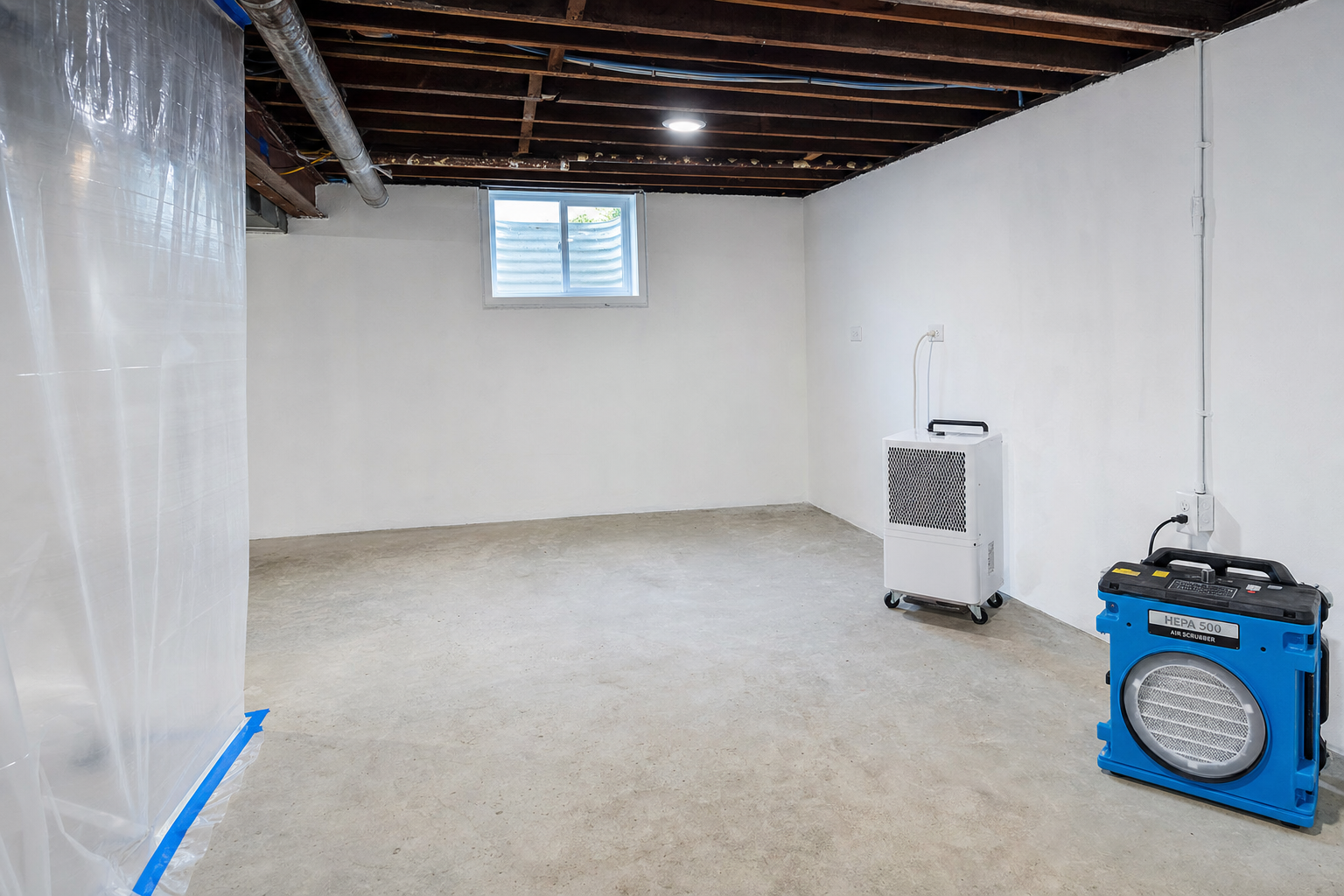 Illustrative example · representative of typical mold remediation work · not a specific Big Easy customer project
[Problem solved – e.g. “Buyer’s inspection report cleared, closing happened on schedule with lender-accepted paperwork”]
Illustrative example · representative of typical mold remediation work · not a specific Big Easy customer project
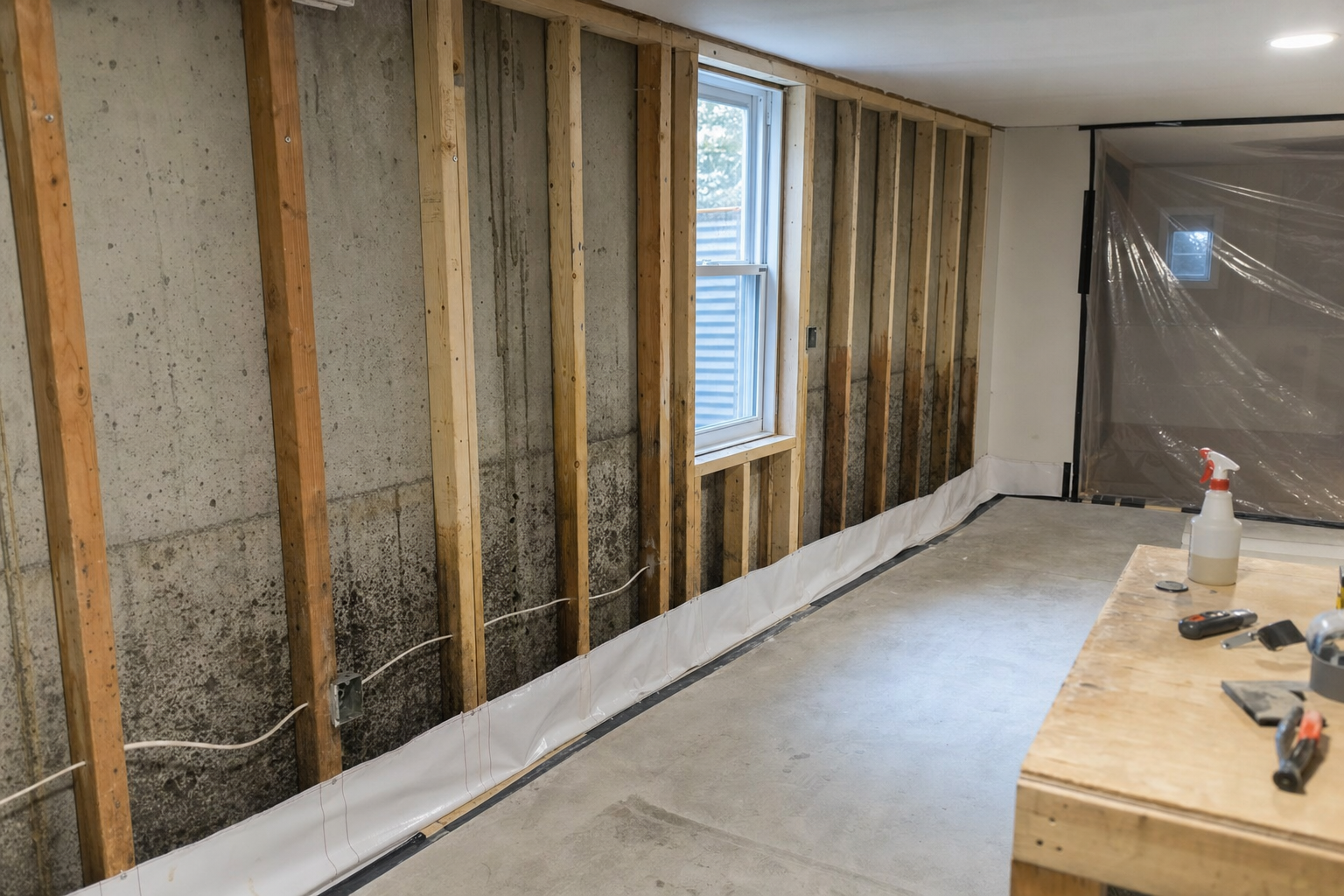 Illustrative example · representative of typical mold remediation work · not a specific Big Easy customer project
[Problem solved – e.g. “Recurring mold tied to foundation crack, fixed at the source, no re-growth 18 months later”]
Illustrative example · representative of typical mold remediation work · not a specific Big Easy customer project
Free Litchfield mold inspection. Written remediation plan within 24 hours.
Sixty minutes on site. Moisture mapping. Visual contamination assessment. An honest plan that distinguishes real contamination from cosmetic mildew – and quotes accordingly.
- Full thorough visual + moisture inspection
- Humidity readings at every affected zone
- Surface sampling sent to certified lab if visible growth present
- Written remediation plan emailed within 24 hours
- Lender-accepted clearance test included on every job
- Honest answer if it’s really a ventilation/humidity issue, not a remediation project
Book your free inspection
No obligation. Written estimate within 24 hours.
Tell us what is happening with your basement and we will email a written estimate within 24 hours. No cost, no obligation, no high-pressure follow-up.
Get a Free InspectionMore from Big Easy