
Service · Connecticut & New York · Since 1994
Crawl Space
Repair.
Vapor barrier encapsulation, dehumidification, structural supports. Convert your damp, musty crawl space into a sealed, stable, year-round dry foundation – without running an HVAC line.
Free crawl space inspection with moisture mapping. Written estimate within 24 hours. Typical install: 2 to 3 days.
- Full encapsulation
- Lifetime moisture warranty
- 2–3 day install




Three signs your crawl space is the problem
If any of these match your home, the crawl space is the source.
Crawl spaces are the most ignored foundation in residential construction – and usually the source of moisture problems homeowners blame on everything else. These are the three triggers we see most often.
Visible water after storms
Puddles on the slab after a heavy rain. Water stains at the wall-floor joint. A finished basement that smells damp 48 hours after a storm. This is hydrostatic pressure pushing groundwater through the path of least resistance.
Get a Free InspectionDamp musty smell year-round
Even when you can’t see water, you can smell it. Mustiness is mold spores feeding on moisture in your basement air. Long-term it damages stored belongings, drywall, and the air quality of the floors above.
Get a Free InspectionEfflorescence on the walls
White, chalky, crystalline residue on your foundation walls. That’s salt left behind as water evaporates through the masonry. It’s not the problem – it’s the symptom that water is actively moving through your foundation.
Get a Free InspectionWhat’s actually going on down there
Why vented crawl spaces fail (and what encapsulation actually does).
The vented crawl space is one of the worst ideas the residential construction industry ever standardized. The theory was that outside air would dry the crawl space. The reality, especially in CT and NY summers, is that humid outside air enters the cool crawl space and condenses on every surface inside, fueling rot, mold, and structural decay. The 1990s building science consensus reversed the recommendation. Crawl spaces should be sealed and conditioned, not vented.
On top of vapor loading, vented crawl spaces in this region carry two more pressures. The stack effect: warm interior air rises through the house and pulls cold humid crawl space air up into the living space, which is why 40 to 60 percent of the air you breathe upstairs originated below the first floor. Structural settlement: undersized or rotting piers and girders sag over decades, causing the sloping floors you feel as you walk across an older Cape or Colonial. Encapsulation, proper supports, and dehumidification fix all three at once.
Walk through a typical job
What a crawl space repair job actually looks like.
- 01
Day one: assessment, debris removal, and prep
We assess piers, girders, joists, and any visible moisture or mold. Old vapor barrier (if any), debris, and rotted framing are removed and bagged out through a containment exit. Vents are temporarily closed.
- 02
Day two: structural supports and pier work
Where joists or girders are sagging, SmartJack-class adjustable steel supports are installed on poured concrete bases. Rotted sill plates or rim joists are sistered or replaced as scoped. Settled piers are stabilized with shims and steel plates as the engineering tables permit.
- 03
Day three: vapor barrier and wall sealing
A 20-mil reinforced polyethylene vapor barrier is laid across the entire floor and mechanically fastened up the foundation walls. Seams are taped with butyl seam tape. Vents are permanently sealed with rigid foam and tape. The crawl space is now a sealed conditioned envelope.
- 04
Day three or four: dehumidifier and final walk-through
A SantaFe Ultra98 or comparable crawl-space-rated dehumidifier is installed and ducted to a condensate drain. We bring the relative humidity below 50 percent and hold it there. You get a walk-through, the warranty paperwork, and the closeout documentation.
Why CT and NY homeowners pick Big Easy for crawl space work.
What other contractors get wrong
Encapsulate. Don’t condition.
Some contractors will tell you to run an HVAC line into your crawl space – heating and cooling it like the rest of your house. Expensive to install. Even more expensive to run forever. Wrong solution.
The right move is to seal the moisture out, not condition the air inside. A proper encapsulation plus a dedicated crawl-space dehumidifier costs less than HVAC conditioning, works better, and lasts indefinitely. Here is exactly how we do it.
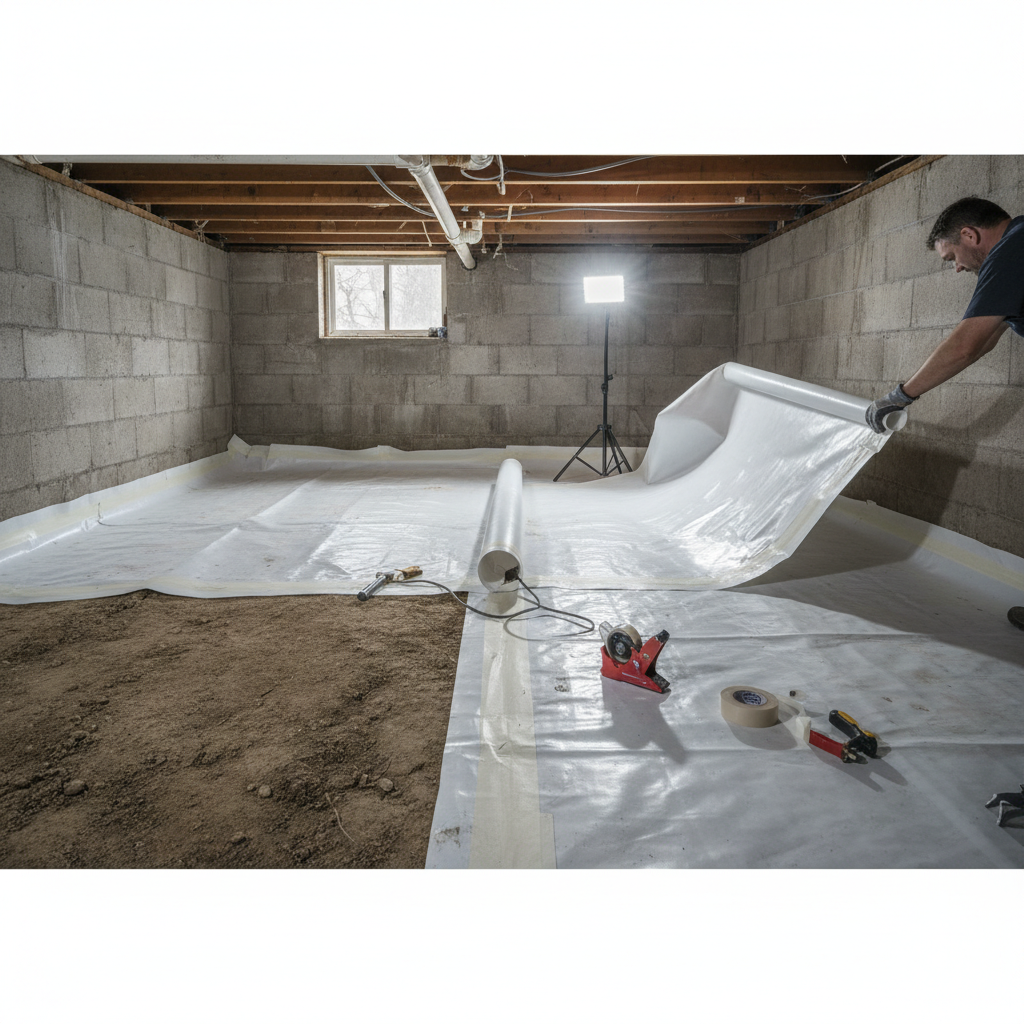
Free inspection
A specialist examines every foundation wall, every existing drain, every moisture sign. We document with photos and measurements. You get a written estimate within 24 hours – no high-pressure follow-up.
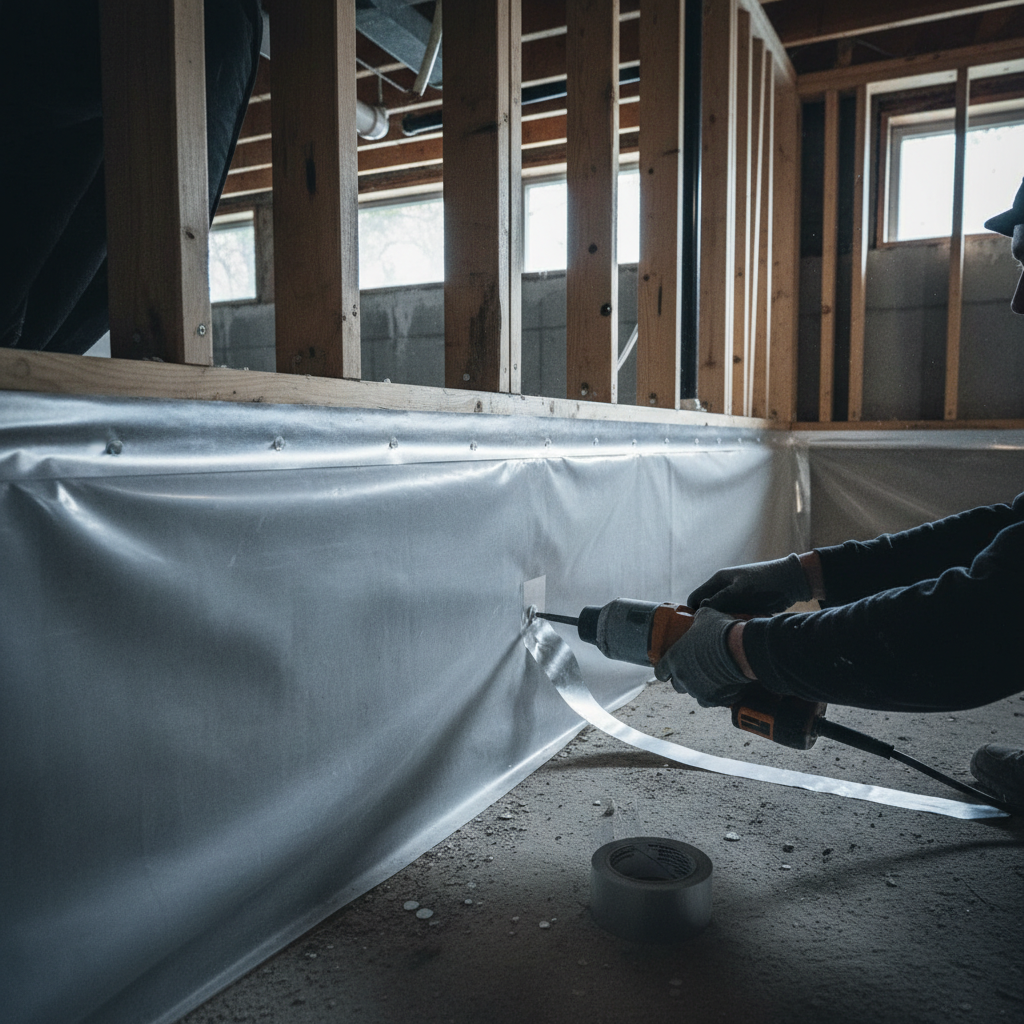
Cut perimeter trench
We carefully saw-cut a 4-to-6-inch-wide trench around the interior perimeter where the foundation wall meets the slab – right above the existing footing. Dust controlled at the source. No demolition outside this strip.
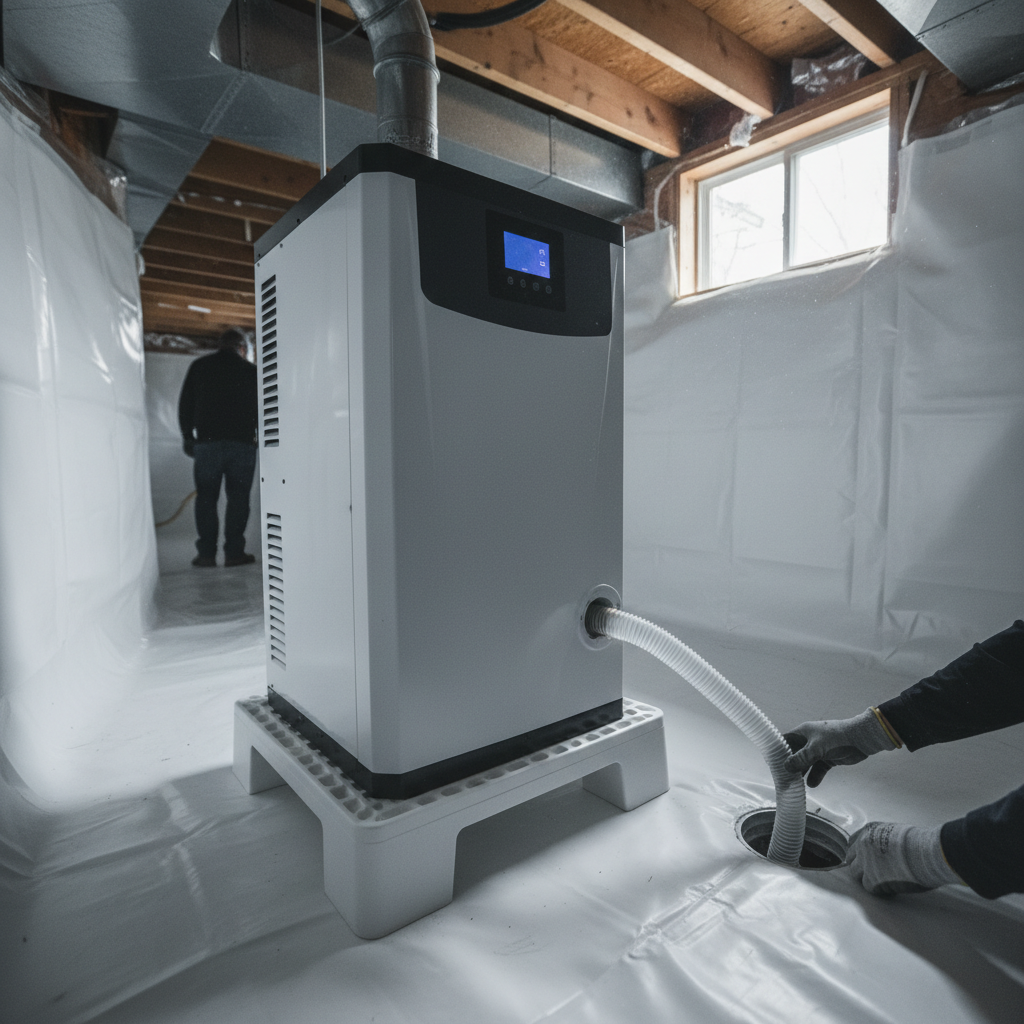
Install drain + sump system
Perforated PVC drainpipe laid in clean stone, pitched toward a sump basin we install in the corner. Battery backup pump included as standard. Discharge line routed outside, below CT/NY frost depth so it never freezes shut.
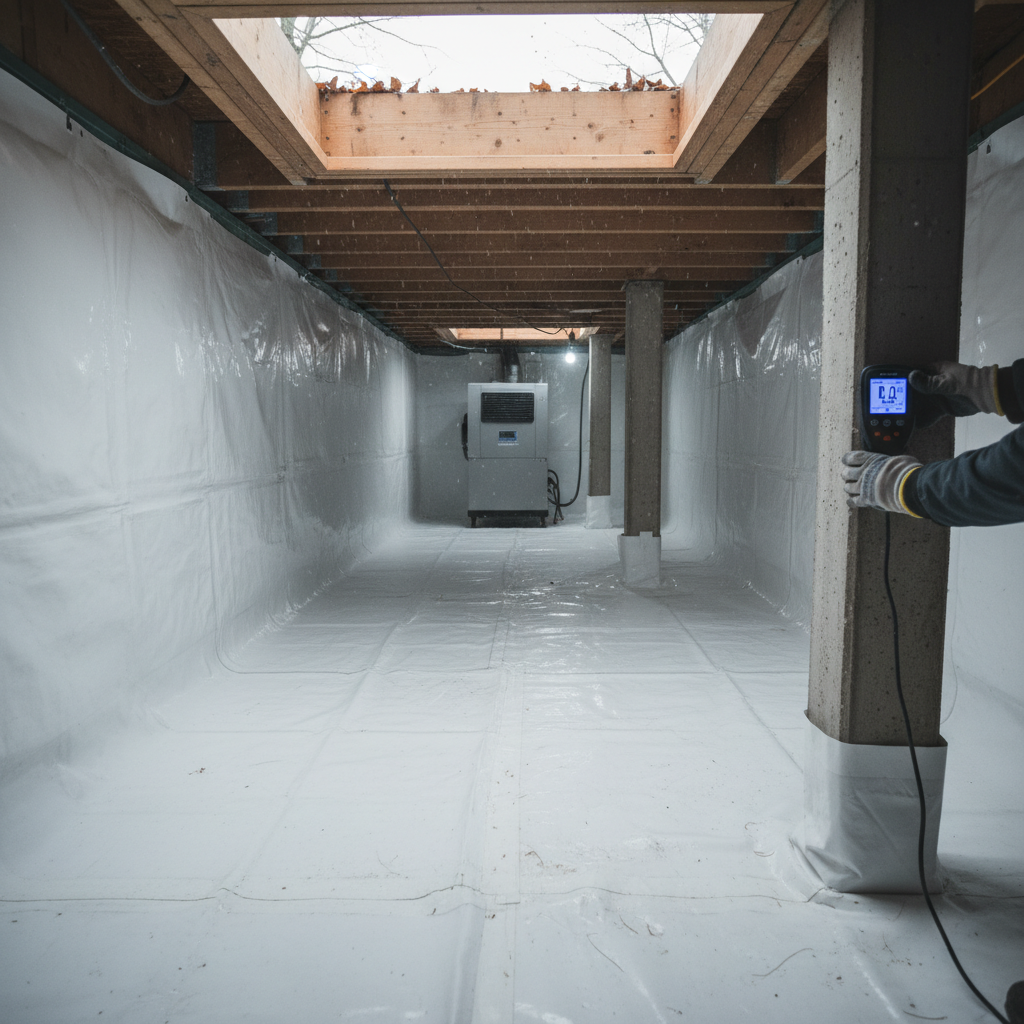
Vapor barrier + restore slab
Wall vapor barrier installed and sealed to the new drain. Concrete poured back over the trench, finished smooth. The basement looks essentially the same as when we arrived – only now it stays dry, with a lifetime warranty in writing.
When converting to a full basement makes more sense
A very small percentage of crawl spaces (deep, tall, dry to begin with, with enough ceiling height to convert to usable space) make better candidates for conversion to full basement than encapsulation. We’ll tell you if yours qualifies. Most don’t – encapsulation gives you 90% of the dryness benefit at 30% of the cost.
Equipment we trust
Equipment and materials we install.
Crawl space repair is a category where low-grade materials fail catastrophically because the environment is humid, dirty, and unconditioned. We use the equipment that actually holds up over 20 years.
- Vapor barrier: 20-mil reinforced polyethylene, mechanically fastened to foundation walls with seam tape rated for crawl space conditions. Not the 6-mil construction poly that tears within a year.
- Structural supports: SmartJack-class adjustable steel supports on poured concrete bases. Rated load is calculated against the engineering tables for the joist or girder being supported.
- Dehumidifiers: SantaFe Ultra98 or Aprilaire E100 crawl-space-rated commercial dehumidifiers, ducted to a passive condensate drain so there is no water reservoir to empty.
- Insulation: Closed-cell spray foam against the rim joist and sill plate. Where the crawl space is conditioned, foundation walls can be insulated with rigid foam board.
- Sump and drainage (when applicable): Where groundwater intrusion is part of the picture, the same Zoeller M53 or M98 primary pump with battery backup we install in basements is used in the crawl space sump basin.
- Sealants: Polyurethane and butyl sealants rated for ground contact at vent closures, wall terminations, and pier penetrations.
What you actually get in writing
Warranty and what is covered.
Our crawl space encapsulation work carries a written lifetime warranty against vapor barrier failure (delamination, separation from foundation walls, or seam failure). If the barrier fails for any reason within our control, we return and repair at no charge.
Structural support installations carry a separate written lifetime warranty against further movement at the supported location. If a SmartJack-supported beam or joist measurably deflects beyond the post-install reading, we re-stabilize at no charge.
The warranties are transferable to the next homeowner one time at no cost during a property sale. Dehumidifier and sump pump manufacturer warranties run separately and we administer the claims on your behalf.
What voids the warranty: cutting or puncturing the vapor barrier, removing structural supports, or modifying the dehumidifier installation without notifying us. Annual inspection is offered as a flat-rate service visit and is recommended but not required.
Real crawl space projects in CT and NY.
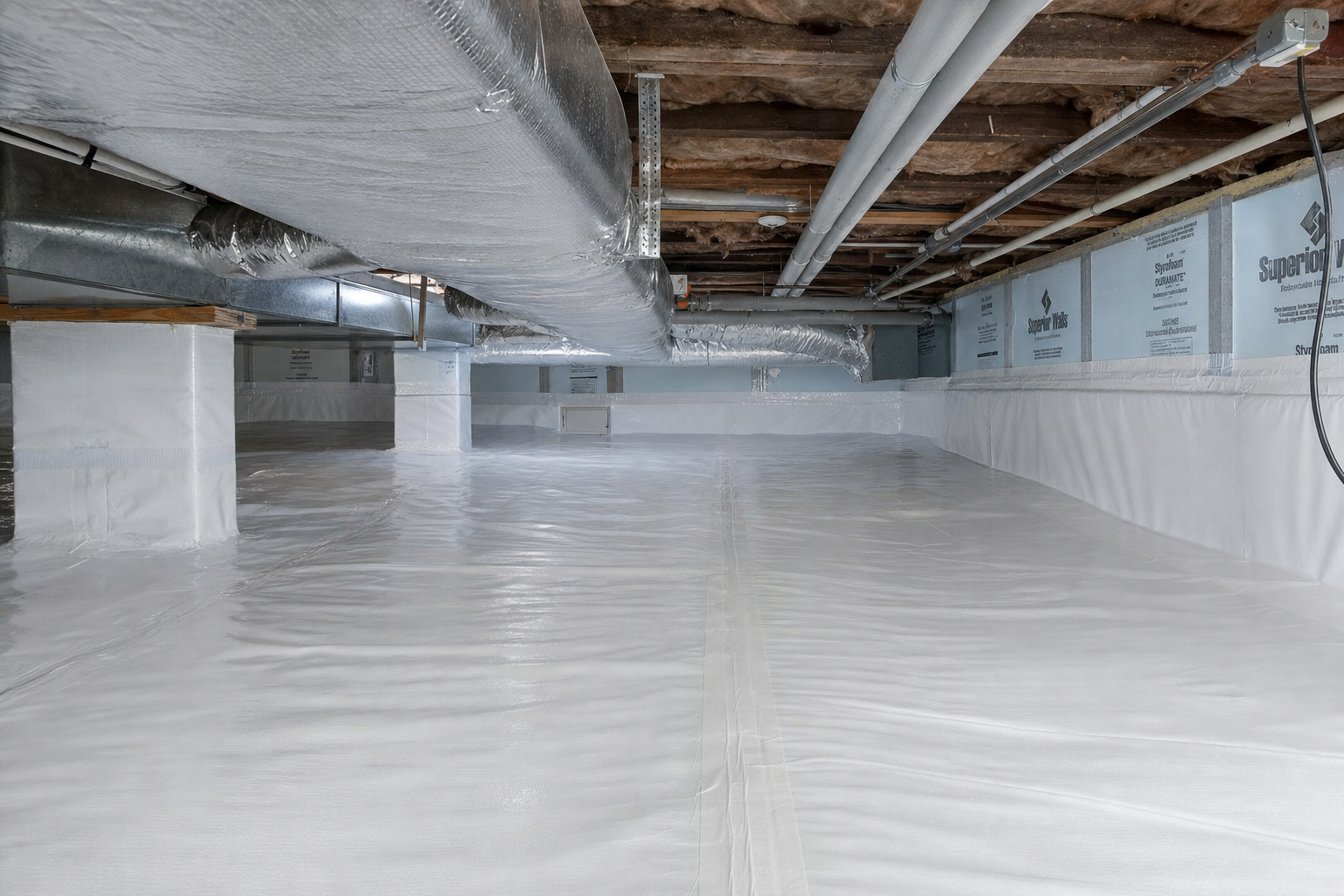 Illustrative example · representative of typical crawl space repair work · not a specific Big Easy customer project
[Problem solved – e.g. “Whole-house musty smell eliminated, joists stabilized, dehumidifier maintains crawl at 50% RH year-round”]
Illustrative example · representative of typical crawl space repair work · not a specific Big Easy customer project
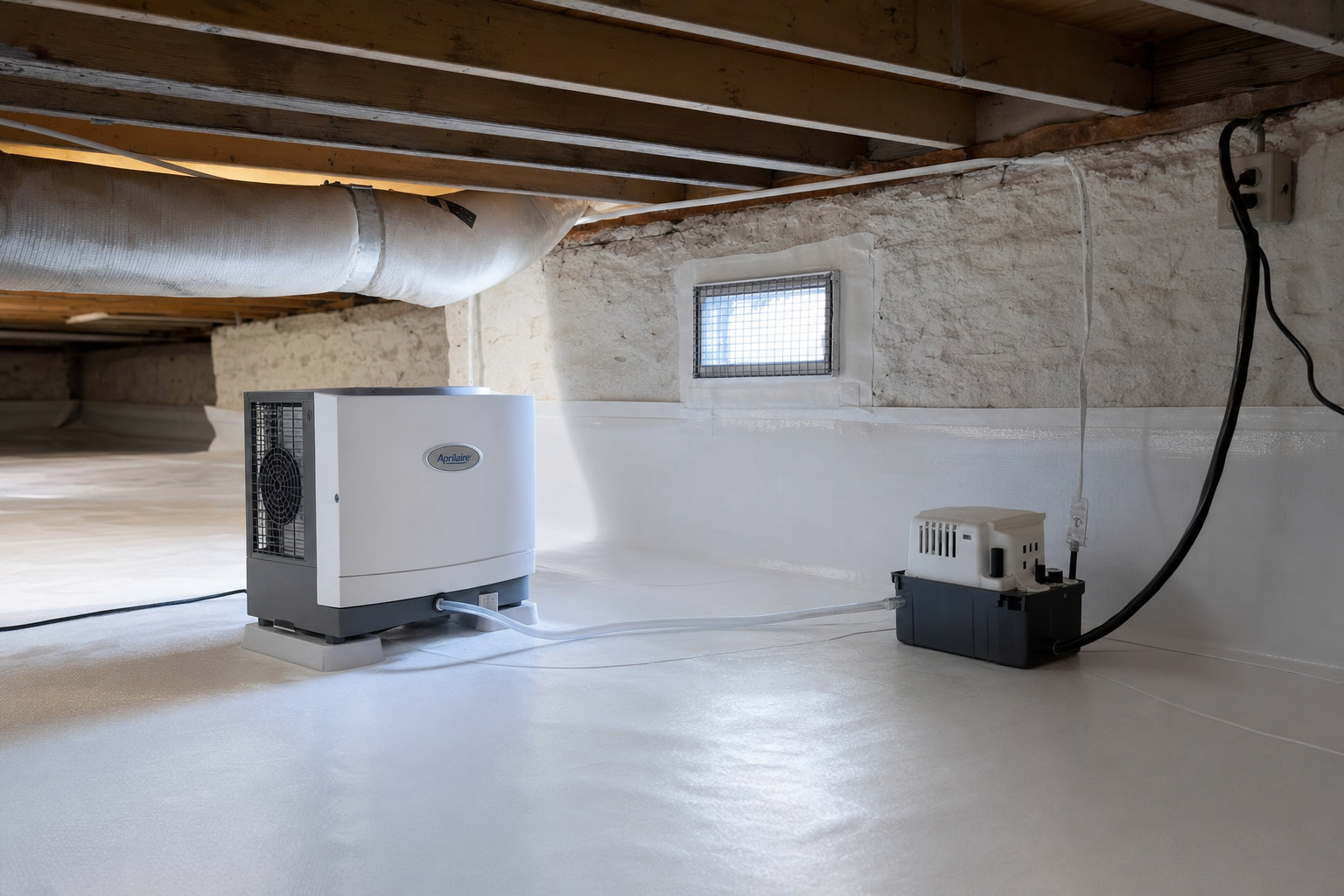 Illustrative example · representative of typical crawl space repair work · not a specific Big Easy customer project
[Problem solved – e.g. “Sagging family room floor restored to level, moisture source eliminated”]
Illustrative example · representative of typical crawl space repair work · not a specific Big Easy customer project
Honest pricing
How much does crawl space repair cost?
Honest range: $4,000 to $15,000 depending on size and scope. Most CT and NY crawl space projects land between $6,500 and $10,500. Three factors move the number.
- Square footage and accessibility. A 600 square foot crawl space with 3 feet of headroom is faster than a 1,400 square foot crawl space with 18 inches of clearance. Tight crawl access multiplies labor hours significantly.
- Structural work included. A vapor-barrier-only encapsulation is at the low end. Adding SmartJack supports, sistered joists, or replaced sill plates raises the scope. We itemize structural work separately so you can stage it if needed.
- Dehumidifier and drainage additions. Adding a commercial dehumidifier with condensate drain adds $1,800 to $2,800. Adding a sump basin and pump (when groundwater is a factor) adds $1,500 to $2,500. Both are commonly recommended in CT and NY but priced separately so you see the impact.
Permits, where the municipality requires them for structural work, are included in the quote.
CT and NY specifics
CT and NY crawl spaces: regional realities.
Crawl spaces in the Northeast carry a specific set of problems that make encapsulation worth the investment.
- Frost depth: CT IRC code sets footing depth at 42 inches. Pre-1950 crawl space piers were routinely set shallower and have heaved and settled for decades. We assess piers individually and stabilize with SmartJack supports where deflection has occurred.
- Humid summer cycles: June through September outdoor dew points sit above 60 degrees most days. Vented crawl spaces condense that moisture on cool joists, fueling rot and mold. Sealing the vents and dehumidifying is the only durable answer in this climate.
- Soil belts: Hudson Valley clay holds groundwater against crawl space foundation walls year-round. Litchfield County rocky till can drain well or pool at bedrock seams depending on the lot. Soil drives whether the project needs a sump in addition to encapsulation.
- Pre-1970 housing stock: Older Capes, Colonials, and farmhouses across Fairfield, Litchfield, Westchester, and Putnam counties have undersized girders and joists by modern standards. Sagging floors above are almost always a sign that the crawl needs structural work, not just encapsulation.
Where we work
Towns we repair crawl spaces in.
We serve homeowners in Stamford, Greenwich, Norwalk, Danbury, Hartford, West Hartford, Litchfield, White Plains, Yonkers, Carmel, and Poughkeepsie, plus surrounding towns within a one-hour drive of those hubs.
Coverage spans Fairfield, New Haven, Litchfield, and Hartford counties in Connecticut, plus Westchester, Putnam, and Dutchess counties in New York. If your town borders one of these counties and you’re not sure we cover it, call and ask. We usually do.
Common questions homeowners ask
Frequently asked questions
Why seal the vents? My contractor said crawl spaces need to breathe.
That recommendation reflects pre-1990 building science. Modern crawl space research, including studies by Advanced Energy and the Building Science Corporation, demonstrates that sealing the crawl space and conditioning it produces drier, healthier conditions than venting in humid climates like CT and NY. Sealed crawls are now permitted by current IRC code.
Will encapsulation eliminate the musty smell upstairs?
Yes, in the majority of cases. The stack effect pulls air from the crawl space up into the living space continuously. Sealing the crawl and dehumidifying breaks that air pathway. Most homeowners notice the upstairs smell improvement within a week of project completion.
Can I encapsulate the crawl space myself?
A handy homeowner can lay a vapor barrier. Proper encapsulation requires mechanically fastening the barrier to foundation walls, sealing seams with butyl tape, closing vents permanently with rigid foam, addressing the rim joist with closed-cell foam, and installing a properly sized dehumidifier with condensate drainage. The cost of doing it wrong is a redo within 2 years.
How long does crawl space repair take?
Most CT and NY crawl space encapsulation projects finish in 3 to 5 working days. Adding structural supports or sump installation adds 1 to 2 days. We provide a written schedule before work begins.
Will encapsulation save me money on heating?
Most homeowners see a 10 to 20 percent reduction in heating and cooling costs after encapsulation, depending on the leakiness of the original crawl and the efficiency of the upstairs envelope. The savings come from eliminating the conditioned-air loss into the unsealed crawl space.
What about radon in a sealed crawl space?
Sealing the crawl space does not increase radon levels, but it does seal in radon if a high-radon condition already exists. We recommend a radon test before any encapsulation project in CT and NY because both states have areas of elevated radon potential. If levels are high, we install a radon mitigation system as a separate scope.
Free crawl space inspection. Written estimate within 24 hours.
We’ll go down there. Most contractors won’t (it’s tight and uncomfortable). You get photos, humidity readings, and a written estimate – without us ever asking you to crawl through it yourself.
- Full crawl space crawl-through (we go down there, not you)
- Humidity readings at multiple zones
- Written estimate emailed within 24 hours
- Moisture meter on every wood member
- Photo documentation of every damage point
- Honest opinion if a basement conversion would serve you better
Book your free inspection
No obligation. Written estimate within 24 hours.
Tell us what is happening with your basement and we will email a written estimate within 24 hours. No cost, no obligation, no high-pressure follow-up.
Get a Free InspectionMore from Big Easy