
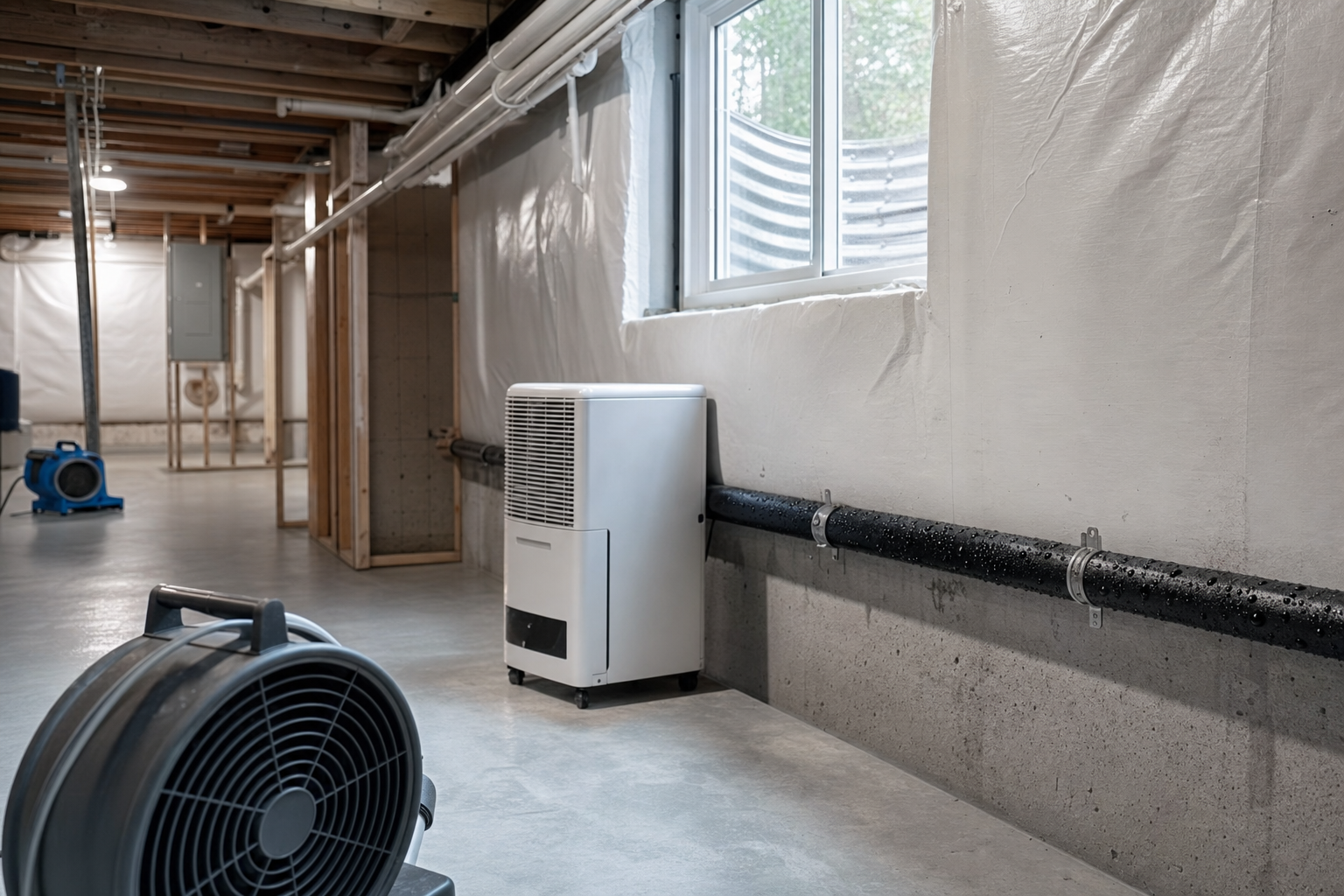
A muggy basement in July is not the same problem as a wet basement in April. Most basements in Connecticut and the Hudson Valley run above 60% relative humidity from late June through early September, and a lot of homeowners assume that is just how basements smell. Sometimes that is true. Sometimes it is the first sign of a moisture source you cannot see.
Why our region runs humid in summer
Long Island Sound, the Hudson River, and the southern New England coastline pump moisture-saturated air through Connecticut and the lower Hudson Valley from late May through September. Outside dew points routinely exceed 65 degrees Fahrenheit for weeks at a time. A dew point above 60 degrees is the threshold where condensation forms on any surface cooler than the dew point. Basement walls and slabs in our climate sit at 58 to 65 degrees year-round, which puts them squarely in the condensation band for most of the summer.
Fairfield County, Westchester County, and lower Dutchess County see this pattern most aggressively because of proximity to the coast. Litchfield County and northern Hartford County run slightly drier but still spend weeks above the condensation threshold.
What is normal in a Northeast basement
Unconditioned basements pull air from outside, and outside air in a CT or NY summer is loaded with water. When that warm, humid air hits the cool foundation walls and slab, the water condenses, the same way a glass of iced tea sweats on a porch table.
A reading of 55 to 65% relative humidity in July, with no visible water and no musty smell, is in the normal range for an unfinished basement. It does not need waterproofing. It might benefit from a dehumidifier sized for the square footage.
When humidity becomes the problem
Humidity is doing damage when:
- Readings stay above 70% for weeks at a time.
- You smell mildew or that wet-cardboard smell that survives ventilation.
- Wood (joists, framing, stored furniture) feels damp to the touch.
- Rust is forming on tools, water heaters, or ductwork.
- Cardboard boxes are softening or growing surface mold at the bottom.
At sustained 70%+ humidity, mold colonies can establish on organic surfaces within a few days. Carbon steel starts to corrode. Wood begins to absorb moisture that affects its structural properties over time.
How to tell where the moisture is coming from
Grab a $15 hygrometer from any hardware store and take readings in three spots: near the basement stairs (where conditioned air leaks in), in the middle of the space, and against an exterior wall. If the wall reading is significantly higher than the middle reading, you have water entering through the wall, not just condensing from outside air.
A piece of clear plastic taped flat against the wall overnight tells you the same thing. Condensation on the room side means you are pulling humidity from indoor air. Condensation on the wall side means moisture is moving through the foundation itself.
The four moisture sources we typically find
1. Outdoor air infiltration
Open basement windows, leaky basement doors, and unsealed rim joists let warm humid air pour into the basement, where it condenses on cool surfaces. This is the easiest source to fix and the most common one homeowners overlook.
2. Wall-source moisture
Foundation walls in contact with saturated soil wick moisture through capillary action even when there is no visible water. Stone, block, and older poured concrete walls all do this to varying degrees. The wall feels dry to the touch but the relative humidity readings on the wall side run five to ten points higher than the room.
3. Slab-source moisture
Concrete slabs poured directly on damp soil without a vapor barrier (common in pre-1970 construction) wick moisture from the ground continuously. A piece of clear plastic taped flat on the slab overnight will show condensation underneath if this is your source.
4. HVAC and plumbing
Sweating ductwork, dripping plumbing connections, condensate lines from air conditioning, and water heater pressure relief valves all add moisture to the basement environment. A 15-minute walk-through with a flashlight catches most of these.
Dehumidifier sizing that actually works
Hardware store dehumidifiers (Frigidaire, GE, LG) handle small basements adequately if the air-source load is moderate. For most CT and NY basements over 1,000 square feet, plan on:
- 1,000 to 1,500 sq ft: 70-pint capacity portable dehumidifier with continuous drain hose.
- 1,500 to 2,500 sq ft: 90 to 110-pint commercial-grade or Aprilaire/SantaFe whole-basement dehumidifier ducted to the supply side.
- Over 2,500 sq ft: Dedicated whole-basement unit, typically Aprilaire E100 or SantaFe Ultra series, with humidistat control.
A SantaFe Ultra98 runs roughly $1,800 to $2,200 installed; an Aprilaire E100 runs $1,400 to $1,800. Both are designed for continuous duty in basement environments. Portable hardware-store units are not, and most burn out within three to five years of full-season operation.
Common summer humidity myths
- “Opening windows will dry it out.” The opposite is true. Warm humid air entering a cool basement increases condensation. Keep windows closed in summer.
- “A bigger dehumidifier solves everything.” A dehumidifier handles air-side moisture. If water is entering through the wall or up through the slab, the dehumidifier runs continuously, drives up the power bill, and never gets the readings down.
- “Concrete is waterproof.” Plain concrete is permeable to water vapor. Foundation walls without a vapor barrier on the warm side wick moisture continuously.
- “Charcoal or DampRid will handle it.” Passive desiccants saturate within days in our climate and stop working entirely. They are not a substitute for active dehumidification.
Timeline of damage at sustained high humidity
- Days 1 to 7: Surface condensation, musty smell.
- Weeks 2 to 4: Mold spore germination on organic surfaces (cardboard, drywall paper, wood framing).
- Months 1 to 3: Visible mold colonies, soft-rot on stored materials, rust on exposed metal.
- Months 6 to 12: Insulation degradation, joist surface decay, smell migrating to living space above.
- Years 1 to 3: Structural wood moisture content above 20%, mold remediation required, possible health impact on occupants.
The damage compounds. Catching the problem in week one means a dehumidifier purchase. Catching it in month six means dehumidification plus remediation. Catching it in year two means remediation plus material replacement plus the conversation about whether the basement is safe for finished space.
What to do about it
- Outdoor-air condensation only: A properly sized dehumidifier (70-pint minimum for most CT/NY basements) and tighter sealing at the rim joist and basement windows.
- Wall-source moisture: Interior waterproofing or vapor management is the conversation, not just a bigger dehumidifier. A dehumidifier fighting an active water source is throwing money at the symptom.
- Slab-source moisture: A sealed dimpled subfloor (DRIcore-style) under any finished flooring, plus continuous dehumidification.
- HVAC or plumbing source: Address the specific leak. Insulate sweating ducts with closed-cell pipe wrap; replace failed condensate lines; tighten plumbing connections.
Cost ranges
- Whole-basement dehumidifier install: $1,800 – $3,200 with drainage.
- Rim joist spray-foam sealing: $800 – $1,800 depending on linear feet.
- Interior wall vapor barrier (DMX membrane): $4,500 – $9,000 for full perimeter.
- Full interior drainage with dehumidifier: $12,000 – $18,000 combined.
Three factors move the numbers: basement size, the presence of existing finished space that needs to be opened up, and whether the wall material is poured concrete, block, or stone.
FAQs
What relative humidity should I target?
50 to 55% in summer, 40 to 45% in winter. Below 40% causes wood shrinkage and shrunk-shut HVAC dampers; above 60% supports mold growth.
My basement only smells musty when it rains. Is that a humidity problem?
That is wall-source moisture, not humidity. A dehumidifier will not solve it. The fix is exterior drainage correction or interior perimeter drainage, depending on volume.
Can I finish a basement that has summer humidity issues?
Not without addressing the moisture source first. Finishing over an active humidity problem traps moisture against drywall, insulation, and framing where you cannot see it. The mold problem you build is much harder to fix than the humidity problem you started with.
How long does a whole-basement dehumidifier last?
Commercial-grade units (Aprilaire, SantaFe) typically last 10 to 15 years with annual filter changes. Hardware-store portables average three to five years under continuous duty.
If you are not sure which one you have, that is exactly what a free inspection is for. We can confirm in twenty minutes with a moisture meter and a flashlight whether you have a humidity problem or a water problem. We service basement humidity issues across all of our CT and NY locations.
Book your free inspection
No obligation. Written estimate within 24 hours.
Tell us what is happening with your basement and we will email a written estimate within 24 hours. No cost, no obligation, no high-pressure follow-up.
Get a Free Inspection