
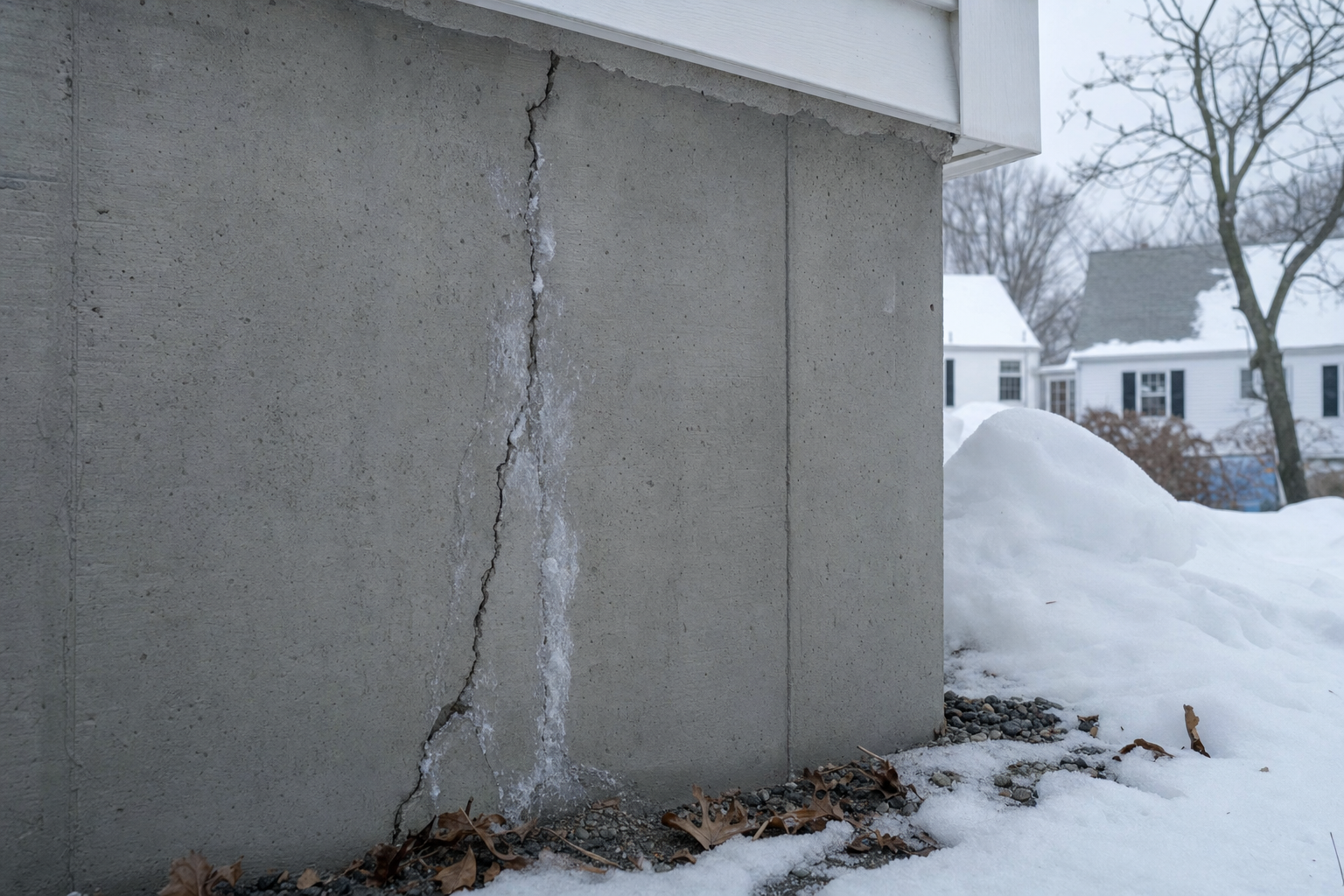
Winter does not cause foundation cracks the way most homeowners think. The damage is rarely from a single hard freeze. It is from repeated freeze-thaw cycles working on water that is already in the wall or in the soil right next to it. Connecticut and the Hudson Valley typically see forty to seventy freeze-thaw cycles between November and March, and each one expands water by about 9% inside any crack or void it has already entered.
Here is what to watch for during the cold months and what each pattern usually means.
The physics of freeze-thaw damage
Water expands roughly 9% in volume when it freezes. That expansion produces pressure on the order of 30,000 PSI inside any confined space. Concrete tensile strength runs 400 to 600 PSI; mortar runs lower. The math is not subtle: water that enters a crack, freezes, and expands wins every time.
The CT IRC sets footing depth at 42 inches to put concrete below the seasonal frost depth, but the foundation wall itself sits in the freeze zone all winter. Every cycle from above freezing to below freezing and back is one ratchet click of crack-widening or spalling.
The four crack types we see most often
Vertical hairline cracks (often harmless)
A single vertical hairline crack, narrower than the thickness of a credit card and not actively leaking, is usually a shrinkage crack from when the concrete originally cured. These do not get worse from freeze-thaw alone unless they are letting water in. Mark the ends with a pencil and check in spring. If they have not lengthened, they are stable.
Repair cost if needed: $400 to $900 per crack for epoxy or polyurethane injection. The injection bonds the crack faces and prevents future water entry.
Horizontal cracks (call us)
A horizontal crack across a poured wall or following a mortar joint in a block wall is rarely cosmetic. It usually indicates lateral pressure from outside soil pushing the wall inward. Freeze-thaw amplifies that pressure when ground water in the saturated soil freezes and expands.
If you are seeing this with any inward bowing, do not wait until spring. Once a wall has bowed more than two inches from plumb, the repair conversation shifts from carbon fiber straps to steel beam bracing or full wall replacement, and the cost difference is roughly 3x.
Staircase cracks in block walls (variable)
Staircase cracks follow the mortar joints in a diagonal step pattern. These can be from settlement, lateral pressure, or both. A staircase crack that is also showing daylight or efflorescence at the joints needs assessment now, not in April. A clean staircase crack with no daylight and no moisture is usually historical and stable.
Cove-joint seepage (very common in winter)
The cove joint is where the basement wall meets the basement floor. Seepage here during a January thaw is one of the most common winter calls we get. It is almost always from hydrostatic pressure underneath the slab, not from a structural failure. Interior drainage solves it; epoxy injection does not.
What freeze-thaw actually does to a crack
Water enters a crack during a melt event. Temperature drops below freezing. The water expands by 9% as it freezes, pushing the crack open slightly wider. Temperature rises again, the ice melts, water settles in deeper, and the cycle repeats. By March, a hairline crack from November can be wide enough to fit a coin.
This is why we tell homeowners that the lowest-cost time to fix a foundation crack is in October, before that first cycle starts. The second-lowest-cost time is right now, before next winter.
Why CT and NY winters are particularly hard on foundations
- High freeze-thaw cycle count. Coastal Fairfield County and the lower Hudson Valley sit in a temperature band that produces more cycles than colder regions to the north (where temperatures stay below freezing for longer stretches).
- Saturated soils from fall rain. Soil entering winter with high moisture content has more water available to freeze and push.
- Older housing stock. Hartford, Yonkers, Poughkeepsie, and downtown Norwalk have housing built before modern perimeter drainage and before air-entrained concrete became standard.
- Road salt and de-icer overspray. Calcium chloride accelerates concrete deterioration. Foundations within four feet of a salted driveway or sidewalk take chemical damage on top of mechanical freeze-thaw damage.
What to check during a January thaw
When the temperature climbs above freezing for a stretch in January or February, walk the basement with a flashlight and look for:
- Active water at the cove joint or in cracks.
- Damp shadows that were not there in November.
- Efflorescence growing along any wall seam.
- A new crack you did not see in the fall walk-through.
- Any ice on the basement floor near a wall (this is a serious sign of active wall seepage that froze on contact with the slab).
Photograph anything new. Send us the photos. We can usually tell from images and a phone call whether it needs immediate attention or whether it is reasonable to wait for warmer weather to schedule the work.
Common myths about winter foundation cracks
- “Wait for spring, the cracks will close up again.” They do not. Freeze-thaw cycling is one-directional damage. Cracks widen over winter and do not narrow back.
- “Caulking from the inside will hold it.” Hydrostatic pressure from the outside pushes any interior caulk back into the basement within months.
- “Heating the basement will prevent cracks.” The cracks form in the wall material from outside-temperature freeze-thaw. Heating the basement does not change the outside soil temperature.
- “My foundation is poured concrete so freeze-thaw is not a concern.” Air-entrained poured concrete resists freeze-thaw better than block, but it does not stop water from entering existing cracks and widening them over winter.
- “I will fix it after the spring thaw shows me what is happening.” By then you have absorbed a full winter of additional damage. Repair cost scales with how far the wall has moved.
Repair cost ranges
- Polyurethane crack injection (single non-structural vertical crack): $400 – $900.
- Carbon fiber strap reinforcement for bowing walls under 2 inches: $4,500 – $7,500 for a 20 foot wall.
- Steel beam bracing for bowing walls over 2 inches: $9,000 – $16,000 per wall.
- Helical or push pier underpinning for settlement cracks: $1,800 – $3,500 per pier, typically 6 to 14 piers per project.
- Interior perimeter drainage for cove joint seepage: $9,000 – $14,000 for a 1,400 sq ft basement.
Three drivers move the numbers: how far the wall has moved (waiting always costs more), access conditions (finished basements add demolition cost), and wall material (poured concrete is the easiest; fieldstone is the most labor-intensive).
Timeline of a winter crack repair
- Day 1: Inspection and written estimate (we deliver within 24 hours).
- Days 2 to 14: Project scheduling. Winter interior work is typically scheduled within 2 weeks during off-peak months.
- Day of work: Polyurethane injection takes 2 to 4 hours per crack including cure time. Carbon fiber strap install runs 1 day with 24 to 72 hours cure. Interior drainage runs 3 to 5 days.
- Post-work: Walkthrough, warranty documentation, final payment.
When to call a pro vs DIY
DIY options: marking existing crack endpoints with a pencil to monitor for growth, photographing wall conditions for comparison, hygrometer placement, cleaning out window wells, confirming sump pump operation with a bucket test.
Call a specialist for: any horizontal crack regardless of width, any new vertical crack wider than a credit card, any bowing or inward deflection, recurring seepage in the same spot, efflorescence above the cove joint, ice formation on the basement floor near a wall.
FAQs
Can foundation work be done in winter?
Interior work yes, year-round. Crack injection, carbon fiber straps, sump pump replacement, interior drainage installation all work in winter. Exterior excavation work is limited once ground temperatures drop below 35 degrees Fahrenheit; we typically schedule those projects for March or later.
How wide is “too wide” for a crack?
A hairline crack (narrower than a credit card) is usually monitor-only. Any crack wider than 1/8 inch warrants assessment regardless of orientation. Any horizontal crack at any width warrants assessment.
Is the warranty transferable?
Yes. Carbon fiber strap repair, interior drainage, and crack injection all carry transferable lifetime warranties. The transferable warranty becomes a selling point on the listing if you sell the home later.
What references the building codes?
Connecticut residential foundation work falls under the Connecticut State Building Code, which references IRC Chapter 4. New York residential work falls under the NY Residential Code R301.2 Climate and Geographic Design Criteria. Both set 42-inch frost depth as the design minimum for footings in our region.
Book your free inspection
No obligation. Written estimate within 24 hours.
Tell us what is happening with your basement and we will email a written estimate within 24 hours. No cost, no obligation, no high-pressure follow-up.
Get a Free Inspection