
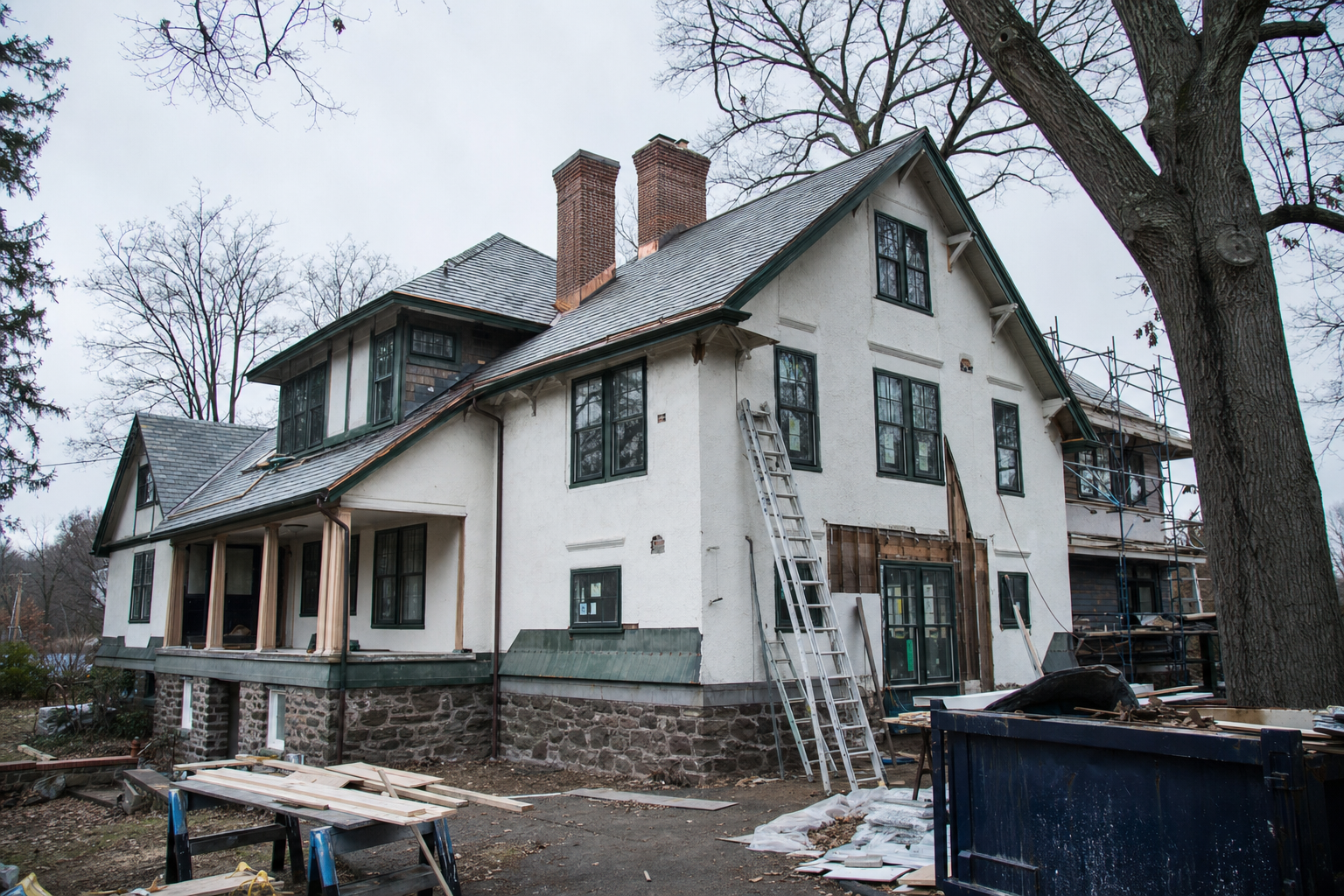
Westchester County’s older housing stock comes with foundation realities that are very specific to homes built before 1950. Modern building science and modern soil drainage solutions were not part of the original construction. Most pre-war homes were built with fieldstone, rubble stone, or early hollow tile foundations, and the assumptions that made sense for that era do not hold up against current standards for dry living space.
Here is what we see most often during Westchester home inspections.
Westchester County in the housing timeline
Westchester saw three distinct housing waves: the railroad-suburb boom of 1880 to 1915 (Bronxville, Larchmont, Scarsdale, Pelham Manor), the post-WWI build-out of 1920 to 1940 (Mount Vernon, New Rochelle, parts of Yonkers and White Plains), and the postwar suburbanization of 1945 to 1965 (most of northern Westchester). Each wave produced different foundation conventions. A buyer or owner looking at a Westchester home needs to know which wave the house came from before assuming anything about the foundation.
The NY Residential Code R301.2 sets the climate and geographic design criteria for the region, with a frost depth of 42 inches for footings throughout Westchester. Foundations from before that code era may not reach that depth in all areas.
Fieldstone and rubble stone foundations
Homes in Bronxville, Larchmont, Scarsdale, and the older sections of Yonkers and New Rochelle were largely built on stacked stone with mortared joints. Over a century, the mortar has eroded, joints have opened, and water now moves through the wall during heavy rain events.
The traditional advice was to repoint the joints. That helps cosmetically but does not solve the underlying issue, because the water is moving through the wall as a system, not just through one joint. Interior drainage with a wall vapor barrier and sump pump is the durable solution.
For homes in historic districts, exterior excavation is often impractical for two reasons: tight lot lines that put the work near neighboring properties, and historic-district review for any exterior alteration. Interior drainage avoids both issues.
Hollow tile foundations
A small but real share of pre-1940 Westchester homes have hollow clay tile foundations. These look like block walls but are made of glazed terra cotta tile, often filled with rubble. They were the low-cost option in their era. Today they are problematic because the tiles crack under thermal and hydrostatic stress, and the interior fill behaves unpredictably.
For hollow tile walls with active failure, the conversation is usually about partial replacement or supplementary reinforcement, not pure waterproofing.
Coal chute and bulkhead seepage
Many older Westchester homes still have abandoned coal chutes or original cellar bulkheads. These are persistent water entry points. The lowest-cost fix is sealing the opening permanently. The middle option is a new code-compliant bulkhead with proper flashing and drainage. We can advise based on how the homeowner uses the space.
Coal chute closures cost $400 to $900 each, including masonry infill and exterior grade matching. New bulkheads run $4,500 to $9,000 depending on configuration.
Stone foundation cracks
Unlike block or poured walls, stone foundations rarely crack across stones. They fail at the mortar joints. A staircase crack pattern in a stone wall almost always means settlement, not lateral pressure. The repair approach is different: stabilization of the affected wall section before any waterproofing is done.
Settlement repair in stone foundations typically requires helical or push piers under the affected footing area. The choice between pier types depends on soil profile and footing condition; both are used in Westchester’s mixed rocky and clay soils.
Common myths about old Westchester foundations
- “100-year-old stone foundations are stronger than modern ones.” They were stronger in lateral compression than modern block. They are not stronger in tension or shear. They are not better at keeping water out. Comparing them to modern construction is comparing different design priorities.
- “Repointing is all I need.” Repointing is cosmetic for above-grade work. Below grade, the water moves through the wall as a system, not just at one joint.
- “My basement has been damp for 80 years and the house is still standing.” Survival is not the standard. Long-term moisture exposure degrades framing, encourages mold, and compounds over years.
- “I have to keep the basement original to preserve historic character.” Interior drainage is fully reversible and hidden. It does not affect any historic above-grade element.
What to ask your inspector
When you are buying or own a pre-1950 Westchester home, ask the inspector specifically:
- Is the foundation fieldstone, hollow tile, or block?
- Are there visible joint failures or efflorescence?
- Is there a sump pump? When was it last replaced?
- Are there abandoned utility penetrations (coal chutes, old fuel oil fill ports, removed bulkheads)?
- What is the slope of the grade around the foundation?
- Is there evidence of past basement flooding (water lines on walls, rust on metal objects, mineral deposits at the cove joint)?
- Is the rim joist insulated and air-sealed?
A good inspector will know to look for these. Many home inspectors give pre-1950 foundations a cursory check because the report templates are not built for them. A specialist follow-up takes one hour and is free.
Cost ranges for Westchester foundation work
- Interior perimeter drainage (1,400 sq ft fieldstone basement): $11,000 – $16,000.
- Hollow tile partial replacement plus reinforcement: $18,000 – $32,000 depending on wall length.
- Coal chute closure: $400 – $900.
- New bulkhead with flashing and drainage: $4,500 – $9,000.
- Helical pier underpinning (settlement repair): $1,800 – $3,500 per pier, typically 6 to 14 piers.
- Sump pump with battery backup: $2,200 – $3,800 installed.
Westchester pricing tends to run 5 to 15% above Hartford for the same scope because of higher labor costs and tighter access on many older lots.
Timeline of typical Westchester work
- Day 1: Free inspection on site, 60 to 90 minutes typically.
- Within 24 hours: Written estimate emailed.
- Project scheduling: 4 to 6 weeks in peak season, 2 to 4 weeks off-peak.
- Interior drainage install: 3 to 5 days for a typical home.
- Walkthrough and final payment: Day of completion.
FAQs
My basement is in a historic district. Can you still do the work?
Interior drainage typically does not trigger historic district review because the work is not visible from outside. Exterior excavation usually does. We design around the historic constraints in most cases.
Will the work affect the original stonework appearance?
From the exterior, no. From the interior, the wall stays visible if you leave the basement unfinished, or gets covered by a dimpled vapor barrier that protects the stone behind framing if you plan to finish.
Is the warranty transferable?
Yes. Lifetime transferable on workmanship for interior drainage, carbon fiber, and crack injection. Manufacturer warranties on pumps and other equipment transfer per the manufacturer terms.
How do I know if my hollow tile foundation is failing?
Look for: bulging or bowing in the wall plane, visible cracks running through the tile face (not just along mortar joints), efflorescence concentrated in specific tiles, sounds of cracking during cold weather. Any of these warrants assessment.
Free assessment for Westchester homeowners
We do free inspections across Westchester County. Written estimate within 24 hours. We will tell you honestly whether your foundation needs immediate attention or whether it is in the normal range for a 100-year-old home.
Book your free inspection
No obligation. Written estimate within 24 hours.
Tell us what is happening with your basement and we will email a written estimate within 24 hours. No cost, no obligation, no high-pressure follow-up.
Get a Free Inspection