
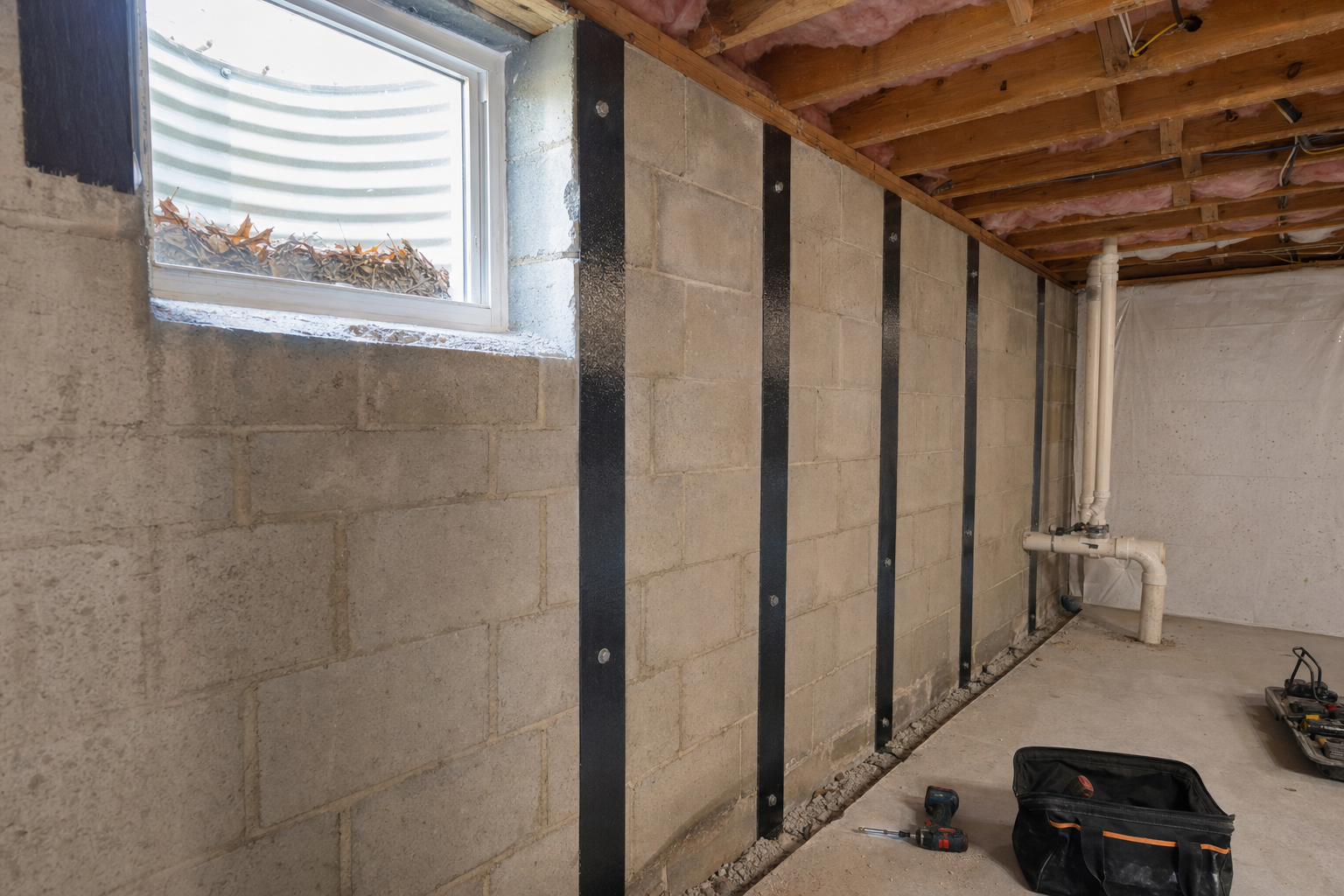
Bowing basement walls are one of the most common foundation problems we see in older Connecticut and New York homes, especially block foundations built between 1920 and 1970. The cause is usually lateral pressure from saturated soil pushing inward over decades. Left alone, a bowing wall progresses slowly until it does not, at which point repair costs jump by an order of magnitude.
Carbon fiber strap reinforcement is one of two main repair options (the other is steel beam bracing). Here is when carbon fiber is the right call and how the installation actually works.
Why CT and NY have so many bowing walls
The mid-century housing boom in Connecticut and New York produced thousands of homes with 8-inch concrete block (CMU) foundations. Block walls have inherent vulnerability to lateral pressure compared to poured concrete. Combine that with our regional soil conditions (clay-heavy in Fairfield County, glacial till with seasonal saturation in Litchfield, rocky fill with poor drainage in Westchester), our 42-inch frost depth, and 60 to 80 years of freeze-thaw cycling, and the result is a predictable failure pattern.
The wall does not fail suddenly. It bows inward at a rate of roughly 1/16 to 1/4 inch per year, with most of the movement happening during spring saturation events. By the time the homeowner notices it, the wall has typically been moving for 10 to 20 years.
When carbon fiber works
Carbon fiber straps are appropriate when:
- The wall is bowing inward two inches or less from plumb.
- The wall has no active shear failure (no visible step in the wall plane).
- The cracking pattern is horizontal across the wall, not severe staircase.
- The basement has at least 5 feet of headroom (some installs work in less).
- The sill plate is intact and properly attached to the wall.
- The floor slab is intact at the wall base (no significant cove joint failure).
If the wall is bowing more than two inches, leaning at the top, or showing active shear, carbon fiber alone is not enough. We move to steel beams or, in severe cases, exterior excavation and replacement.
What the install looks like
Step 1: Surface preparation
The wall surface is ground smooth where each strap will be installed. Vertical strap locations are typically spaced four to six feet apart along the affected wall section. Each strap is roughly 4 to 6 inches wide and runs the full height of the wall from sill plate to floor.
The grinding removes any paint, sealer, efflorescence, or loose mortar that would prevent good epoxy bond. The prep takes 30 to 45 minutes per strap location. Dust shrouds and HEPA vacuums keep airborne concrete dust to a minimum.
Step 2: Epoxy application
A two-part structural epoxy is mixed and applied to the cleaned wall surface in the strap location. This epoxy is the adhesive that bonds the carbon fiber to the wall, and it is what carries the structural load.
Epoxy spec matters. We use structural epoxy with a tensile strength of at least 7,500 PSI and a modulus of elasticity matched to the carbon fiber product. Off-the-shelf hardware-store epoxy is not rated for this application; it cures harder than the carbon fiber and creates a stress concentration that defeats the repair.
Step 3: Carbon fiber placement
The carbon fiber strap is rolled into the wet epoxy and pressed flat with a hard roller, working out air bubbles. A second coat of epoxy is applied over the strap. Top and bottom anchors are installed where the strap meets the sill plate and the floor slab.
The anchors at top and bottom are critical. A carbon fiber strap without proper anchors transfers load to the middle of the wall, which is where you do not want load. Properly anchored straps transfer load from the wall to the sill plate above and the floor slab below.
Step 4: Cure
The epoxy cures over 24 to 72 hours depending on temperature and humidity. The wall is structurally restored once the cure is complete. We typically advise homeowners not to load the wall (no leaning against it, no hanging anything from it) for 72 hours after install.
What carbon fiber does and does not do
Carbon fiber straps stop further inward bowing. They do not push the wall back to vertical (no system does, short of full exterior excavation and reset). The wall stays where it is at the time of repair, but is prevented from moving further.
This is important to understand before signing. If the cosmetic finish of the wall matters (in a finished basement, for example), the bow will still be visible after repair. The repair is structural, not cosmetic.
Carbon fiber vs steel beam bracing
- Carbon fiber: Lower cost ($4,500 – $7,500 for a 20-foot wall), 1 day install, hidden behind drywall later, lifetime transferable warranty. Works for bowing under 2 inches.
- Steel beam (I-beam or C-channel) bracing: Higher cost ($9,000 – $16,000 per wall), 1 to 2 day install, visible inside the basement (impossible to hide behind standard drywall), lifetime warranty. Works for bowing 2 to 4 inches and can sometimes recover a small amount of movement under tension.
For most CT and NY homes with bowing detected before it exceeds 2 inches, carbon fiber is the right call: lower cost, hidden install, equivalent structural performance.
Cost and timeline
For a typical 20 foot foundation wall with five to six straps, the project runs $4,500 to $7,500 and takes one day for install plus the cure time. The repair carries a transferable lifetime warranty.
Three cost drivers within the range:
- Number of straps required (5 to 6 for a 20-foot wall is typical; more for severe bow or longer walls).
- Wall surface condition (clean poured concrete is fastest; pitted block or stone adds prep time).
- Access conditions (finished basements with drywall already up add demo and re-finish cost).
Common myths about carbon fiber straps
- “Carbon fiber will push the wall back to vertical.” It will not. No interior-only repair recovers significant wall movement.
- “Straps every 8 feet are enough.” Spacing depends on wall height and bow severity. 4 to 6 feet on center is the standard for 8-foot tall walls with moderate bow.
- “Carbon fiber is the lower-cost option, so the warranty must be weak.” Properly installed carbon fiber strap repair carries a transferable lifetime warranty equivalent to steel beam systems.
- “You have to wait until the wall stops moving to install.” The opposite is true. Earlier intervention prevents further movement and costs dramatically less than waiting.
Materials and warranty terms
- Carbon fiber straps: Unidirectional carbon fabric, typically 24 oz/sq yd or equivalent, with tensile strength of 550,000+ PSI.
- Structural epoxy: Two-part, 7,500+ PSI tensile strength.
- Top anchor: Steel angle or proprietary bracket fastened to sill plate.
- Bottom anchor: Embedded steel plate or proprietary bracket fastened into the floor slab.
- Warranty: Transferable lifetime on workmanship; manufacturer-specific on materials (typically 25 years to lifetime).
When to call a pro
This is professional-only work. The cost of incorrect installation is loss of structural performance: improperly bonded straps separate from the wall within months, anchors pulled into block fail at the first heavy soil load, and the homeowner is out the cost of the install and still has a bowing wall.
DIY-appropriate work in this category: measuring bow with a 4-foot level held vertically, photographing the wall with a measurement reference, monitoring crack endpoints with pencil marks. Anything beyond monitoring should be left to a foundation specialist.
FAQs
How do I measure the bow?
Hold a 4-foot level vertically against the wall at its midpoint. Measure the gap between the top of the level and the wall at the top, and the bottom of the level and the wall at the bottom. The larger gap is the bow measurement. Any gap over 1/2 inch warrants assessment; any gap over 1 inch is a priority call.
Will the repair affect my home’s resale value?
Yes, positively. A documented professional foundation repair with transferable lifetime warranty is a positive factor on a buyer’s inspection. An uncorrected bowing wall is a negative factor that typically reduces offer prices by two to three times the cost of the repair.
Can I finish the basement after the repair?
Yes. The straps are flat against the wall and can be furred over with framing and drywall. We recommend a 1-inch furring gap from the wall to maintain vapor airflow.
Do you also address the underlying cause?
We have to. Stopping the wall from moving without fixing the cause of the lateral pressure means the next wall section is loaded harder. Most carbon fiber projects also include surface drainage corrections (downspouts, grading) and often interior perimeter drainage to relieve hydrostatic pressure on the wall.
When to call us
Any inward bow of more than an inch warrants assessment. Bowing tends to accelerate once it starts, and the cost of repair scales with how far the wall has moved. Free inspection, written estimate within 24 hours, no pressure on the call.
Book your free inspection
No obligation. Written estimate within 24 hours.
Tell us what is happening with your basement and we will email a written estimate within 24 hours. No cost, no obligation, no high-pressure follow-up.
Get a Free Inspection