
Litchfield, CT · Litchfield County · Since 1994
Foundation Repair in Litchfield, CT.
Cracks, bowing walls, settlement. Carbon fiber straps, helical piers, structural crack injection – engineered fixes that match the wall and the soil, without replacing your entire foundation. Lifetime warranty in writing. Tuned for Litchfield’s split foundation populations: pre-1850 dry-laid fieldstone-rubble walls under the Borough Historic District homes around the Green, and 1950s through 80s poured-concrete and cinder-block foundations on the rural-acreage parcels in Northfield, Milton, and East Litchfield – both shaped by the most aggressive freeze-thaw load in the region.
Free Litchfield structural inspection. Written estimate within 24 hours. Most engineered repairs completed in a single day, dust-controlled. Historic District Commission coordination handled for Borough properties.
- Engineered repairs
- Lifetime warranty
- Most jobs done in 1 day
Three foundation symptoms common across Litchfield housing eras
If any of these match what you’re seeing, get it inspected.
Litchfield’s housing stock splits between pre-1850 dry-laid fieldstone-rubble foundations in the Borough Historic District and 1950s-onward poured-concrete and cinder-block foundations on the rural-acreage parcels. The failure modes match the era. Caught early, all three of the symptoms below are fixable in a day – and the Litchfield Hills freeze-thaw load means catching them early matters more here than it would on the coast.
Visible cracks (vertical, horizontal, stair-step)
Cracks in concrete block, poured walls, or pre-1850 fieldstone-rubble masonry. Vertical cracks usually indicate settlement. Horizontal cracks signal lateral pressure pushing on the wall – the failure mode we see most often on Litchfield’s mid-century rural cinder-block foundations after a wet spring melt. Stair-step cracks in fieldstone foundations across the Borough Historic District track decades of freeze-thaw movement through lime-mortar joints. The repair has to match the crack type, the wall era, and the soil beneath the footing.
Get a Free InspectionBowing or leaning walls
A foundation wall measurably out of plumb. Saturated glacial till after spring snowmelt, undermined footings on hillside lots, or frost-heave at the perimeter (Litchfield reliably reaches the full 42-inch CT frost depth) all push masonry walls inward. Common on the 1950s and 60s rural ranches in Northfield and Milton where the original exterior drainage failed. Treated early, this is a one-day fix with carbon-fiber straps or steel wall anchors. Left untreated on a Litchfield foundation it is a wall replacement.
Get a Free InspectionSticking doors or windows
Doors that suddenly will not close. Windows that will not open. Diagonal drywall cracks running from corners of openings. These are settlement symptoms – the foundation telling you it has moved. On the pre-1850 fieldstone-rubble foundations under the Borough Historic District, this is usually localized footing settlement on glacial-till hillsides that helical piers can stabilize without replacing the historic masonry wall.
Get a Free InspectionBuilt for Litchfield, CT
What makes Litchfield basements different.
Foundations across Litchfield were built for the era they were built in, and the failure modes split sharply by neighborhood and decade. Pre-1850 dry-laid fieldstone-rubble foundations under the Litchfield Borough Historic District homes – along North Street, South Street, West Street, and East Street radiating from the Green – settle, move at the lime-mortar joints, and lose their pointing under nearly two centuries of freeze-thaw cycles. 1950s through 80s poured-concrete and cinder-block foundations across Northfield, Milton, and East Litchfield bow under lateral pressure when the original perimeter drainage stops working, develop shrinkage cracks at corners, and settle on glacial-till hillsides under hillside-lot conditions. The repair tools – carbon-fiber straps, helical piers, structural crack injection, steel wall anchors, restoration-grade repointing for the historic stock – are different tools for different failures. On a Litchfield Hills lot, with the deepest freeze-thaw load in the region accelerating every mode, matching the tool to the wall, the soil, and the era is what separates a fix from a Band-Aid.
- ZIP coverage. Service covers Litchfield ZIPs 06750 and 06759.
- Litchfield areas. Service covers Litchfield areas including the Borough Historic District along North Street, South Street, West Street, and East Street, plus Bantam, Northfield, Milton, and East Litchfield – spanning both of Litchfield’s dominant foundation eras.
- Adjacent towns. We also serve nearby Bantam, Goshen, and Morris.
- Frost depth. Footings on every job we run extend below the 42-inch frost line required by the Connecticut State Building Code.
Why Litchfield homeowners pick Big Easy for foundation repair across both housing eras.
Litchfield foundation repair · common questions
Questions Litchfield homeowners ask before scheduling.
Do you handle pre-1850 dry-laid fieldstone foundations in the Borough Historic District?
Yes. The historic Borough stock requires restoration-grade repointing, selective rebuilding of failed sections, and helical-pier stabilization on settled corners. The work coordinates with the Litchfield Historic District Commission where the wall is visible from the public way. We have worked on the pre-1850 housing stock around the Green and on the historic streets radiating from it.
Do I need a permit for foundation repair in Litchfield?
Most structural foundation work in Litchfield requires a permit and an inspection. We coordinate the permit application with the Town of Litchfield Land Use Office, the engineer’s letter where the repair requires one, the inspection sign-off, and Historic District Commission review for Borough properties – all as part of the project.
How long does a typical foundation repair take?
Most single-wall foundation repairs in Litchfield complete in a single working day, dust-controlled at the work zone. Larger projects involving multiple walls, helical-pier work on settled rural-acreage foundations, or restoration-grade repointing on Borough fieldstone can run 2 to 5 days. The written estimate breaks it out before any work starts.
How do I know if it is structural or cosmetic?
Hairline vertical cracks under 1/8-inch in poured concrete are usually cosmetic. Horizontal cracks, stair-step cracks at corners, measurable wall bowing, lime-mortar joints that have lost their pointing on fieldstone walls, and any crack that has actively moved on a date-marked pencil line over 30 to 60 days are structural. The inspection rules it in or out and documents either way in writing.
What the industry default gets wrong
Stabilize. Don’t replace.
The default in our industry for a foundation problem is “tear out the wall, pour a new one.” Twenty-five to eighty thousand dollars. Weeks of disruption. Often unnecessary.
Most CT and NY foundation problems can be stabilized – permanently – with carbon fiber straps, helical piers, or structural wall anchors. Engineered to spec. Warranted for life. Completed in a day. The wall stays. The repair is invisible after we restore the cosmetics. Here is exactly how we do it.
Free structural inspection
A specialist examines every wall, measures wall plumb with a level, photographs every crack, identifies pattern type. You get a written diagnosis and engineered repair recommendation within 24 hours.
Engineer determines repair method
Carbon fiber straps for stable cracks. Helical piers for active settlement. Wall anchors for bowing walls. Sometimes a combination. Every method is engineered to spec – we don’t eyeball this.
Install reinforcement (dust-controlled, 1 day typical)
Carbon fiber adheres directly to the wall in hours. Helical piers install through the slab without exterior excavation – In Litchfield that means seating piers to CT’s 42-inch frost-depth bearing, often through rocky glacial till. Wall anchors tie the wall back to undisturbed soil. Most jobs done in a single day.
Cosmetic restoration + lifetime warranty in writing
Epoxy crack-fill, surface refinish, slab patch where piers entered. The repair is invisible. The warranty is on paper, signed by the owner, transferable when you sell the home.
When full replacement IS the right call
About 5% of the foundation problems we see genuinely need replacement – catastrophic structural failure, advanced settlement beyond what piers can correct, or wall material that’s failed at the aggregate level. We’ll tell you straight on the free inspection. We won’t sell you carbon fiber on a wall that needs to come down – and we won’t sell you a full rebuild on a wall that just needs reinforcement.
Real foundation repair projects in CT and NY.
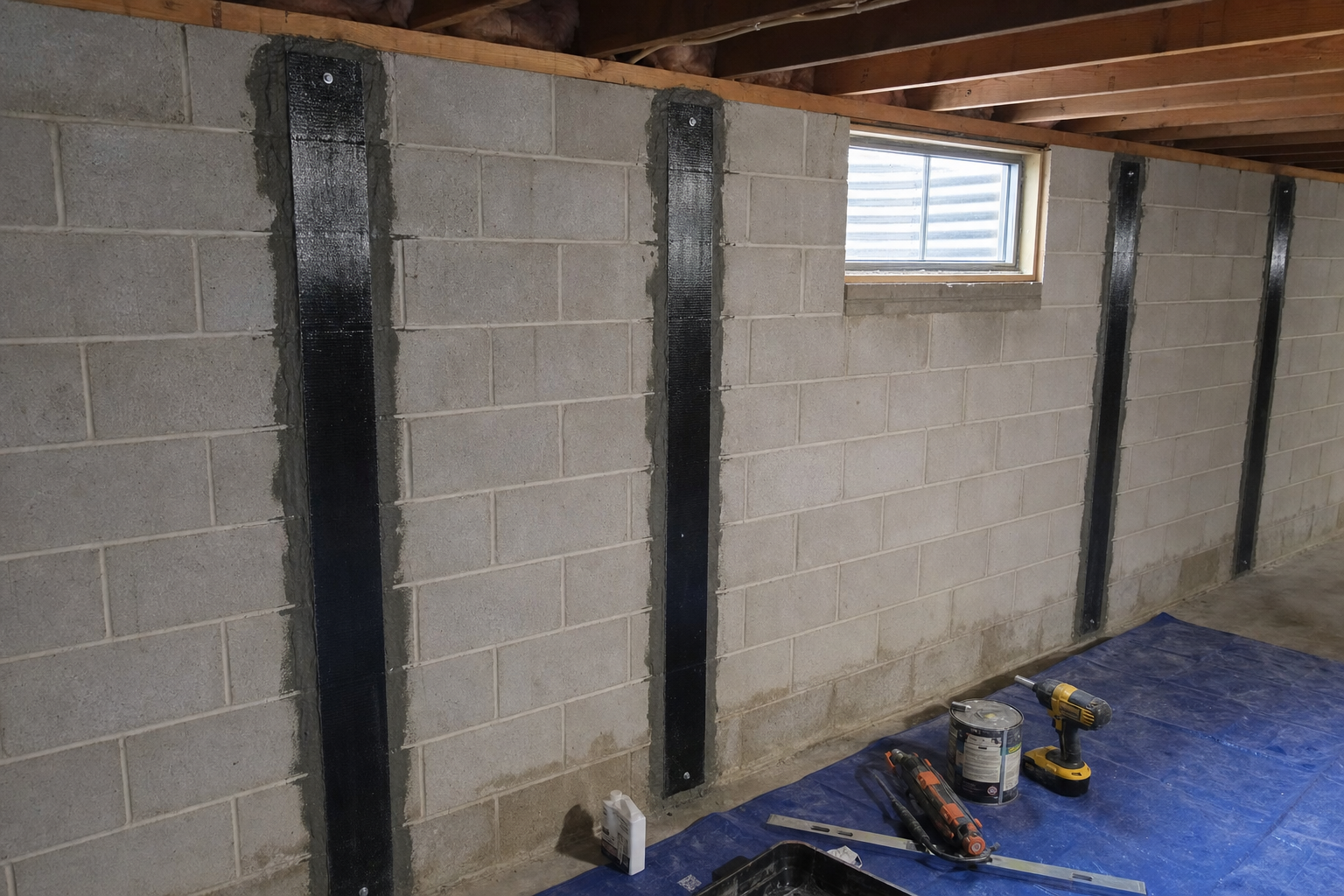 Illustrative example · representative of typical foundation repair work · not a specific Big Easy customer project
[Problem solved in one sentence – e.g. “Bowing block wall stabilized, basement finishing project saved without exterior excavation”]
Illustrative example · representative of typical foundation repair work · not a specific Big Easy customer project
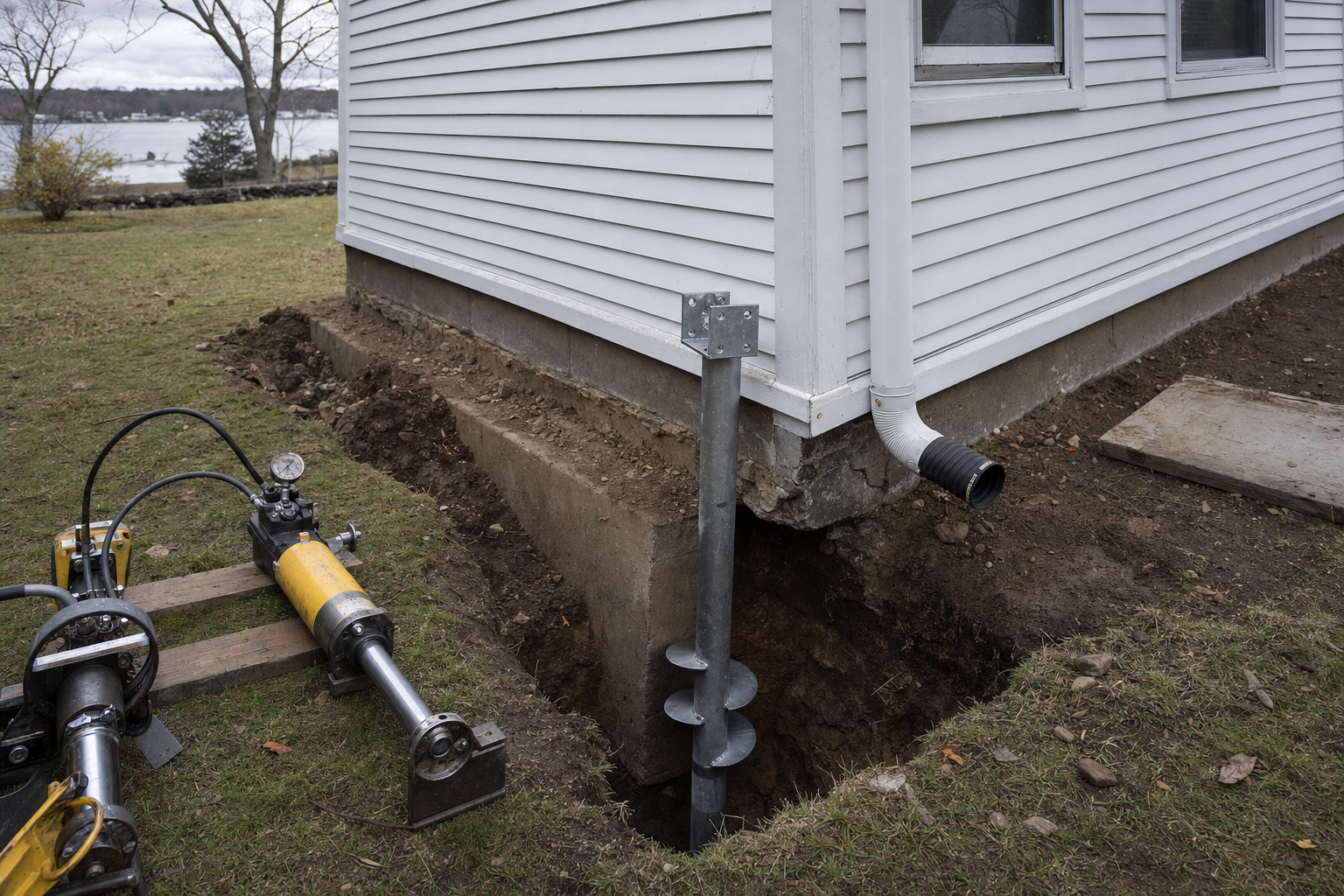 Illustrative example · representative of typical foundation repair work · not a specific Big Easy customer project
[Problem solved in one sentence – e.g. “Advanced settlement halted before structural failure, doors and windows realigned”]
Illustrative example · representative of typical foundation repair work · not a specific Big Easy customer project
Free Litchfield structural inspection. Written estimate within 24 hours.
Sixty minutes on site. Photo documentation. Wall-plumb measurements. An honest engineering opinion – including when you DON’T need the expensive option.
- Full thorough structural walk-through
- Photo documentation of every crack and movement pattern
- Wall-plumb measurements at every foundation wall
- Engineered repair recommendation, written
- Honest answer if full replacement is the right call – or isn’t
Book your free inspection
No obligation. Written estimate within 24 hours.
Tell us what is happening with your basement and we will email a written estimate within 24 hours. No cost, no obligation, no high-pressure follow-up.
Get a Free InspectionMore from Big Easy