
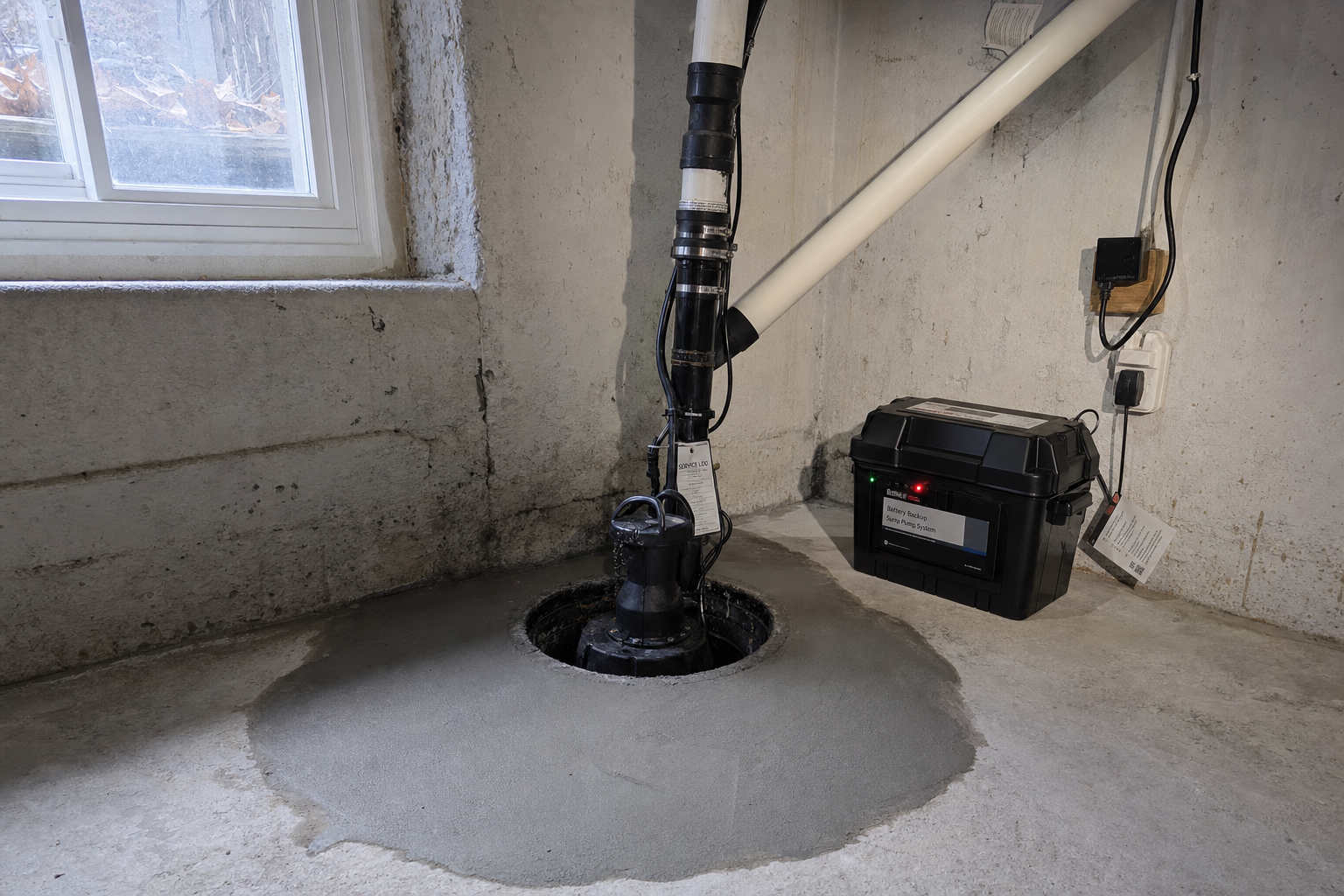
Most sump pump failures are not from manufacturing defects. They are from undersized pumps trying to clear water faster than they were ever built to handle, or from oversized pumps short-cycling themselves into early burnout. Picking the right capacity for your specific basement is the single biggest factor in how long your pump lasts and how reliably it performs during the events you actually need it for.
Here is how we size pumps for Connecticut and New York homes.
How sump pumps are rated
Pump capacity is measured in gallons per hour at a specific vertical lift height (called “head pressure”). A pump rated at 4,200 GPH at 10 feet of lift will move less water than that if your basement has 15 feet of lift to the discharge point, and more if you only have 5 feet.
For most CT/NY basements, the effective lift is between 8 and 15 feet, depending on basement depth and where the discharge exits the home.
Sizing factors that matter
1. Basement square footage and perimeter drainage volume
A 1,000 sq ft basement with full perimeter interior drainage collects a different volume of water than a 2,500 sq ft basement with the same system. More perimeter linear feet means more water reaching the basin during a heavy event.
2. Local groundwater conditions
Fairfield County clay soils hold and release water differently from the sandier soils in parts of Westchester. Dutchess County properties on bedrock have different drainage patterns than properties in alluvial valleys. A pump sized for one site might be undersized for the same square footage on a different lot.
3. Lift height to discharge
Measure from the bottom of the sump basin to the highest point of the discharge line, then add for horizontal run. Every 10 feet of horizontal pipe is roughly equivalent to 1 foot of vertical lift in friction loss.
4. Peak vs continuous duty
A pump that runs for 20 minutes during a thunderstorm has different demands than a pump that runs for 8 hours straight during an April thaw event. We size for the worst realistic case, not the average case.
5. Basin size and cycle frequency
An undersized basin causes the pump to cycle too frequently (short-cycling), which burns out motor windings within months. An oversized basin keeps cycles longer and reduces motor wear. 18-inch diameter is the minimum we install; 24-inch is standard for high-volume sites.
Capacity recommendations we actually use
For a typical 1,500 sq ft Northeast basement with full perimeter drainage and 10 feet of effective lift:
- Primary pump: 1/3 to 1/2 HP, cast iron body, rated at 3,500 to 4,500 GPH at 10 feet of lift.
- Backup pump: Battery-backup unit rated at 2,000 to 2,500 GPH at 10 feet.
- Basin size: 18 inch diameter minimum, 24 inch for higher-volume sites.
Going significantly larger on the primary pump does not help, because the pump will short-cycle and burn out the motor windings. Going smaller leaves you exposed during the events that actually matter.
Recommended pump models for our market
- Zoeller M53 (1/3 HP cast iron): 2,580 GPH at 10 feet. Good for smaller basements with light flow. $300 – $400.
- Zoeller M98 (1/2 HP cast iron): 4,200 GPH at 10 feet. Our default primary pump for most CT/NY homes. $450 – $600.
- Zoeller M267 (1/2 HP, higher head): 4,800 GPH at 10 feet with better high-head performance. Used in deep basements or high-lift discharge configurations.
- Liberty 257 or 287 series: Equivalent specs to Zoeller, slightly different switch design.
For battery backup: deep-cycle marine battery (Group 27 or 31) with a properly matched backup pump (Basement Watchdog, Pro-Series, or equivalent rated 2,000+ GPH at 10 feet).
Battery backup is not optional in our climate
The Northeast loses power during exactly the storms that produce the most water. A primary pump running on grid power is useless during a six-hour outage in the middle of a heavy rain event. Battery backup is standard on every sump pump install we do unless the homeowner explicitly opts out.
The upgrade adds $600 to $1,200 to the project. Most homeowners who skip it call us back within two years asking for it.
Common sizing mistakes
- Picking by horsepower alone. A 1 HP pump in the wrong configuration moves less water than a 1/2 HP pump sized correctly.
- Ignoring head pressure. A pump rated at 5,000 GPH at the discharge port moves only 3,000 GPH at 12 feet of lift. The number that matters is GPH at your specific lift height.
- Same pump for every basement. Contractors who install the same pump regardless of site conditions are not sizing, they are selling.
- Plastic body in a continuous-duty location. Cast iron dissipates heat better and lasts longer under sustained operation.
- Skipping the check valve. A check valve at the discharge prevents backflow when the pump shuts off; without it, the same water cycles through repeatedly and burns out the motor.
Installation cost breakdown
- Pump replacement only (existing basin and discharge): $800 – $1,400.
- New pump with new basin (no discharge changes): $1,400 – $2,200.
- Full new install with battery backup and discharge: $2,200 – $3,800.
- Full system in a previously dry basement (no existing infrastructure): $3,500 – $5,500.
Three drivers: basin condition (cracked or undersized basins need replacement), discharge run length (longer runs cost more), and access (finished basements add demolition cost).
Service interval
Plan on full pump replacement every 7 to 10 years for primary pumps, every 5 to 7 years for battery backups (battery life is the limiting factor). Annual service appointments catch problems early and extend that range.
Annual service typically includes: bucket test, inspection of float switch operation, check valve test, battery voltage check (for backup), filter screen cleaning, and discharge line inspection. Roughly $150 to $250 per visit, less if scheduled with other foundation work.
Discharge planning
The pump moves water out of the basin. Where that water ends up matters as much as the pump itself.
- Minimum distance from foundation: 10 feet. Closer and the water soaks right back through.
- Slope away from house: 1 inch per foot for at least 6 feet of discharge run.
- Freeze protection at wall exit: Standard in our climate. We use IceGuard or equivalent freeze-resistant fittings.
- Termination: Splash block on graded surface, dry well at least 10 feet from the foundation, or daylight discharge if grade permits.
FAQs
How do I know if my current pump is sized right?
Call us with the make and model, your basin diameter, and a rough discharge run length. We can usually tell you over the phone whether your current pump is in the right range or whether you are exposed.
Do I need a primary plus backup or is one enough?
In CT and NY, both. Primary handles normal duty; backup handles power outages during storms. One without the other is half a system.
Will a battery backup pump run my whole basement during an outage?
It will handle the volume of water that triggers the backup, but it is not built for full continuous duty. A typical backup pump on a fully charged battery handles 6 to 10 hours of intermittent operation. If outages routinely exceed 12 hours, consider a small generator that can power the primary pump.
Is the warranty transferable?
Workmanship: yes, lifetime transferable. Pump: manufacturer warranty (typically 3 to 5 years for Zoeller) transfers with the home. Battery: typically 1 to 3 years and may not transfer; check the specific manufacturer terms.
Free assessment
Not sure if your current pump is sized right for your basement? We will tell you for free. Bring us your current pump’s make and model, the basin diameter, and the discharge run, and we can usually tell you over the phone whether you are in the right range.
Book your free inspection
No obligation. Written estimate within 24 hours.
Tell us what is happening with your basement and we will email a written estimate within 24 hours. No cost, no obligation, no high-pressure follow-up.
Get a Free Inspection