
Carmel, NY · Putnam County · Since 1994
Foundation Repair in Carmel, NY.
Foundations across Carmel fail in patterns predictable by era and by what is under the slab. Pre-1900 stone-rubble walls in the Carmel hamlet core and around Mahopac Falls settle and crack as the glacial-till substrate shifts with each freeze-thaw cycle. Postwar cinder-block walls in the I-684 commuter-era stock through Mahopac and Carmel Hills bow under lateral pressure on rocky hillside lots. Bedrock-shallow basements develop their own pattern – seepage at the rock-concrete interface that looks like a crack but is actually a discontinuity. Carbon-fiber straps, helical piers, and structural-grade crack injection are different tools for different problems – we diagnose first and quote second.
Free foundation inspection with photos and measurements. Written estimate within 24 hours. Carbon fiber, helical piers, or crack injection – the tool that fits the failure mode, on stone-rubble, CMU, or bedrock-interface walls.
- Engineered repair, not replacement
- Lifetime structural warranty
- Carbon fiber + helical pier specialists
Three foundation failure modes by era in Carmel
If you see any of these signs, get the diagnostic.
Foundations across Carmel fail in patterns predictable by the era of the house and by what is under the slab. Each pattern responds to a different repair tool – carbon fiber, helical pier, structural-grade injection, or bedrock-interface sealing – never one-size-fits-all.
Horizontal crack or bow in a CMU wall
Postwar cinder-block walls in Mahopac and Carmel Hills bow inward under lateral soil pressure when grade is wrong or gutters were lost on a rocky hillside lot. A horizontal crack across the mortar bed is the warning. Carbon-fiber straps plus grading correction is usually the right answer – helical piers if it has gone past bowing into displacement.
Get a Free InspectionStair-step cracks in stone-rubble
Pre-1900 stone-rubble foundations in the Carmel hamlet core and around Mahopac Falls and Red Mills settle as the glacial-till substrate moves with each freeze-thaw cycle – 60-plus cycles per year at this Highlands elevation. Diagonal stair-step cracks following the mortar joints are the signature. Helical-pier underpinning and structural-grade injection stabilize without rebuilding the wall.
Get a Free InspectionDoors and windows out of square
Doors that no longer latch, windows that stick, gaps opening above doorframes. Your foundation has moved. Could be settlement (subsoil), lateral pressure (rocky-hillside grade), or interface failure at the bedrock-concrete seam. Diagnostic first, then the right tool. We do not pull permits for repairs that do not need them – NY State Residential Code is specific about when an engineer’s stamp is required.
Get a Free InspectionBuilt for Carmel, NY
What makes Carmel basements different.
Foundations across Carmel were laid up or poured for the era they were built in – and on the substrate beneath them. On the housing stock you actually see here, the failure modes are predictable. Pre-1900 stone-rubble walls in the Carmel hamlet core and around Mahopac Falls and Red Mills settle as the glacial-till substrate shifts with each Highlands freeze-thaw cycle. Postwar cinder-block walls in the I-684 commuter-era stock through Mahopac and Carmel Hills bow under lateral soil pressure on rocky hillside lots. Bedrock-shallow basements develop their own failure pattern: seepage and movement at the rock-concrete interface that looks like a crack but is actually a discontinuity. The repair has to match the wall, the substrate, and the era. Carbon-fiber straps, helical piers, structural-grade injection, and bedrock-interface sealing are different tools for different problems, never one-size-fits-all.
- Carmel hamlets + neighborhoods served. Carmel hamlet, Mahopac, Mahopac Falls, Red Mills, Lake Gleneida shoreline, and the Lake Mahopac residential ring.
- ZIP coverage. Service covers Carmel ZIPs 10512 (Carmel hamlet) and 10541 (Mahopac).
- Adjacent Putnam towns. We also serve nearby Kent, Patterson, Southeast (Brewster), Putnam Valley, and Philipstown.
- Frost depth. Footings on every job extend below the 42-inch frost line required by the New York State Residential Code (Title 19 NYCRR Part 1220 / IRC Table R301.2).
Why CT and NY homeowners pick Big Easy for foundation work.
Frequently asked in Carmel
Foundation Repair-specific questions from Carmel homeowners.
Do foundation repairs in Carmel require an engineer’s stamp?
It depends on scope. New York State Residential Code requires a licensed Professional Engineer’s stamp for structural repairs that alter load paths – major underpinning, helical pier systems beyond a certain load class, wall replacement. Cosmetic crack injection, drainage corrections, and carbon-fiber strap installations on minor bows generally do not. We tell you which bucket your repair falls into before any quote, and we coordinate with a NY-licensed PE when one is needed.
How do I know if my foundation problem is settlement, lateral pressure, or bedrock-interface?
Settlement (substrate shifting) typically shows as diagonal stair-step cracks following mortar joints, doors out of square, and gaps opening at door frames. Lateral pressure (soil pushing inward) typically shows as a horizontal crack across a cinder-block mortar bed and visible bowing under load. Bedrock-interface failures show up as seepage along a clean horizontal seam between the rock and the slab or wall. The diagnostic walk we run on the free inspection sorts it – and the right tool (helical pier vs carbon fiber vs injection vs interface sealing) follows.
Can stone-rubble foundations be repaired without rebuilding the wall?
On the vast majority of Carmel hamlet pre-1900 stone-rubble foundations – yes. Helical piers stabilize settled walls without demolishing them. Structural-grade epoxy and polyurethane injection seal hairline cracks permanently. We approach pre-1900 stone walls as historic envelopes worth preserving, not as walls to be replaced. Full wall replacement is a last-resort scope we rarely recommend.
Does the Highlands freeze-thaw cycle affect repair timing?
Exterior excavation work (when scope requires it) is harder to schedule mid-winter because the upper soil is frozen and trench walls behave differently – the Putnam County freeze window runs longer than coastal NY. Interior repairs – carbon-fiber straps, crack injection, helical-pier installation through the slab – run year-round in the conditioned basement and are not weather-dependent. We schedule the urgent stuff first regardless of season.
What the industry default gets wrong
Stabilize. Don’t replace.
The default in our industry for a foundation problem is “tear out the wall, pour a new one.” Twenty-five to eighty thousand dollars. Weeks of disruption. Often unnecessary.
Most CT and NY foundation problems can be stabilized – permanently – with carbon fiber straps, helical piers, or structural wall anchors. Engineered to spec. Warranted for life. Completed in a day. The wall stays. The repair is invisible after we restore the cosmetics. Here is exactly how we do it.
Free structural inspection
A specialist examines every wall, measures wall plumb with a level, photographs every crack, identifies pattern type. You get a written diagnosis and engineered repair recommendation within 24 hours.
Engineer determines repair method
Carbon fiber straps for stable cracks. Helical piers for active settlement. Wall anchors for bowing walls. Sometimes a combination. Every method is engineered to spec – we don’t eyeball this.
Install reinforcement (dust-controlled, 1 day typical)
Carbon fiber adheres directly to the wall in hours. Helical piers install through the slab without exterior excavation – In Carmel that means seating piers to NY’s 48-inch frost-depth bearing, often through rocky glacial till. Wall anchors tie the wall back to undisturbed soil. Most jobs done in a single day.
Cosmetic restoration + lifetime warranty in writing
Epoxy crack-fill, surface refinish, slab patch where piers entered. The repair is invisible. The warranty is on paper, signed by the owner, transferable when you sell the home.
When full replacement IS the right call
About 5% of the foundation problems we see genuinely need replacement – catastrophic structural failure, advanced settlement beyond what piers can correct, or wall material that’s failed at the aggregate level. We’ll tell you straight on the free inspection. We won’t sell you carbon fiber on a wall that needs to come down – and we won’t sell you a full rebuild on a wall that just needs reinforcement.
Real foundation repair projects in CT and NY.
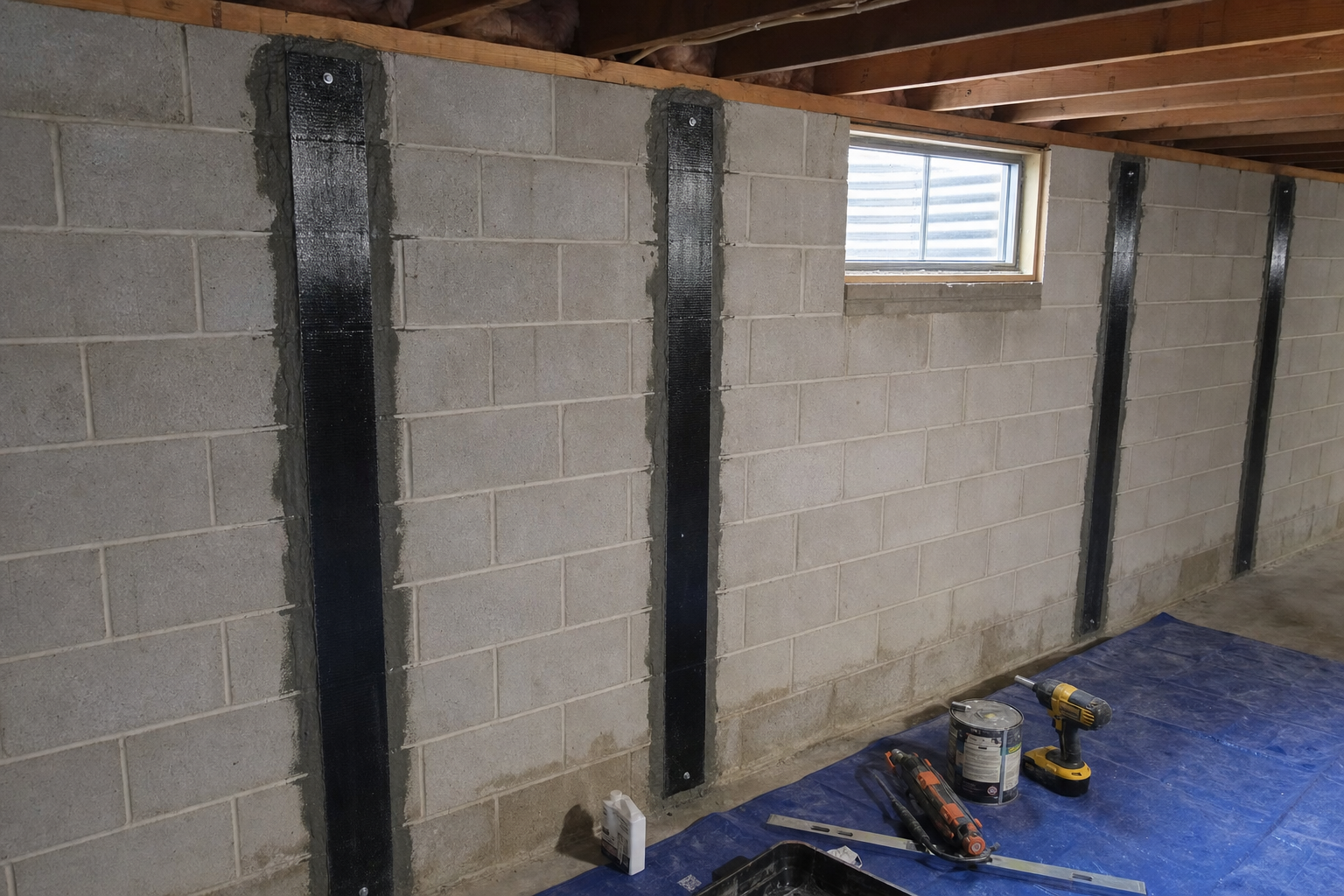 Illustrative example · representative of typical foundation repair work · not a specific Big Easy customer project
[Problem solved in one sentence – e.g. “Bowing block wall stabilized, basement finishing project saved without exterior excavation”]
Illustrative example · representative of typical foundation repair work · not a specific Big Easy customer project
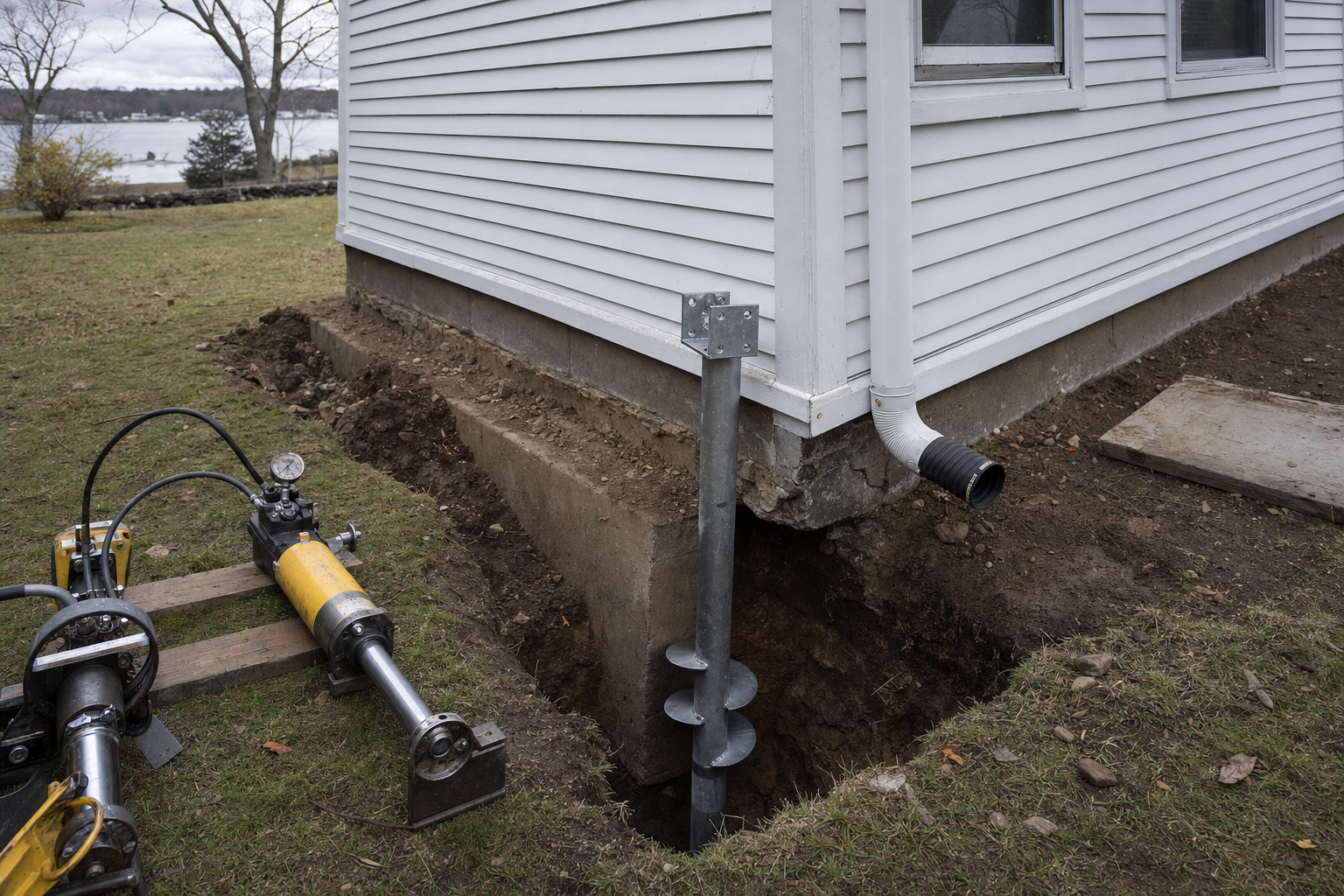 Illustrative example · representative of typical foundation repair work · not a specific Big Easy customer project
[Problem solved in one sentence – e.g. “Advanced settlement halted before structural failure, doors and windows realigned”]
Illustrative example · representative of typical foundation repair work · not a specific Big Easy customer project
Free Carmel foundation inspection. Written estimate within 24 hours.
Sixty minutes on site. Photo documentation. Wall-plumb measurements. An honest engineering opinion – including when you DON’T need the expensive option.
- Full thorough structural walk-through
- Photo documentation of every crack and movement pattern
- Wall-plumb measurements at every foundation wall
- Engineered repair recommendation, written
- Honest answer if full replacement is the right call – or isn’t
Book your free inspection
No obligation. Written estimate within 24 hours.
Tell us what is happening with your basement and we will email a written estimate within 24 hours. No cost, no obligation, no high-pressure follow-up.
Get a Free InspectionMore from Big Easy