
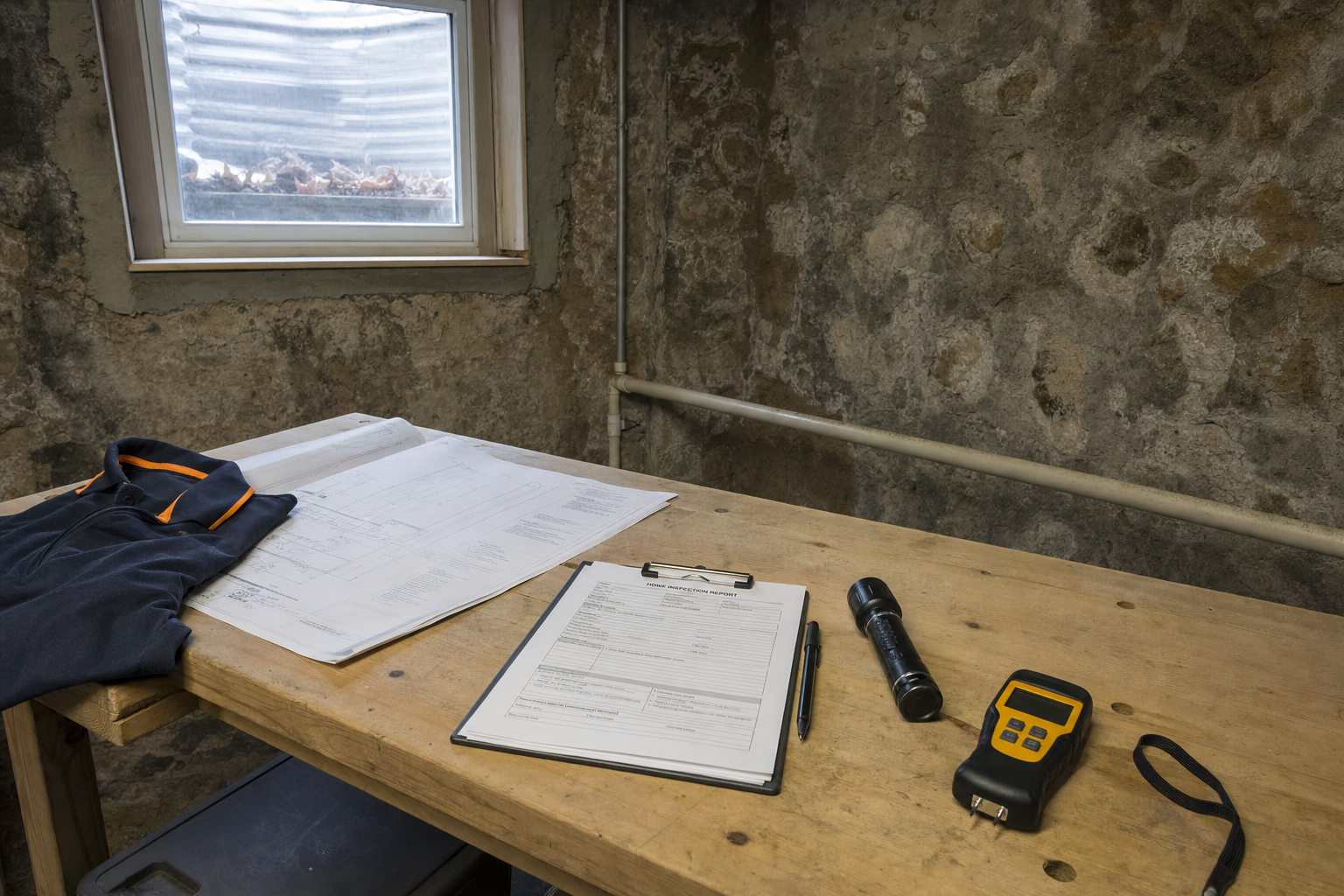
You found a house you like. The inspector said the basement has “some moisture,” used the word “efflorescence,” and recommended “further evaluation.” Now you have 7 days, maybe 10, to decide whether this is a cosmetic note or a $30,000 problem you are about to inherit.
Here is a practical checklist for any CT or NY home buyer staring at an inspection report that mentions basement issues, structured the way our crews think about it when we walk a house for a buyer due-diligence visit.
Why basement issues hit harder in CT and NY housing stock
Most of the housing inventory across Connecticut and the Hudson Valley dates between 1900 and 1965. Hartford, Yonkers, Poughkeepsie, and the older neighborhoods of Norwalk and Stamford run heavy on stone, rubble, and concrete-block foundations that were built before perimeter drainage was standard. Suburbs like West Hartford, Fairfield, and White Plains lean toward mid-century block walls. Frost depth in both states sits around 42″ per the CT IRC and NY R301.2 tables, so footings are deep, which means water can sit against walls for long stretches before grading and drainage steer it away.
A “wet” basement at inspection is not automatically a deal-killer. A “dry” basement at inspection is not automatically safe. What you want to know is whether the conditions add up to a recurring problem or a one-off event.
Step 1: Read the report carefully, not emotionally
Inspectors use language that is calibrated for legal protection, not for actionability. Translate the phrases:
- “Evidence of past moisture” = something happened, at some point. Could have been one event in 1998 or last Tuesday.
- “Efflorescence observed” = mineral salts left behind by water that evaporated. Water moved through the wall. Frequency unknown.
- “Active seepage” = water visible at time of inspection. Almost always serious.
- “Step cracking in block walls” = lateral pressure from soil. Range from cosmetic to structural.
- “Horizontal cracking with bowing” = serious structural concern. Carbon fiber straps or wall anchors required.
- “Hairline cracks in poured walls” = usually settlement, often benign. Vertical hairlines are common.
- “Mineral staining at floor-wall joint” = cove joint seepage. Almost always recurring during wet seasons.
- “Musty odor” = humidity, possible mold. Source matters more than smell.
Step 2: Check the foundation type
The repair playbook depends entirely on what the walls are made of:
- Poured concrete (post-1960): Usually the easiest to repair. Cracks can be epoxy or urethane injected from inside for $400 to $900 per crack. Interior drainage is straightforward.
- Concrete masonry unit / CMU block (1945 to 1990): Hollow cells can fill with water. Step cracking, bowing, and cove joint seepage are common. Repairs are more involved; carbon fiber straps, wall anchors, or interior drainage with weep holes drilled into the cells.
- Stone or rubble (pre-1945): Common in Hartford’s West End, Asylum Hill, Frog Hollow; in Poughkeepsie’s Mansion Square; in Yonkers’ Park Hill and Hudson Hill. Mortar joints fail over decades. Interior drainage with parging and dimpled membrane is usually the right call. Exterior excavation is rarely worth the disruption on these homes.
- Brick foundations: Rare but present in some Greenwich, New Haven, and Hudson Valley pre-1900 homes. Behave similarly to stone; treatment is similar.
Step 3: Inspect the perimeter exterior
Walk the outside of the house with the report in hand. The single largest preventable cause of basement water is exterior grading and drainage failure.
- Does soil slope away from the foundation for at least 6 feet at 5% grade or better?
- Are downspouts terminating at least 5 feet from the foundation, or are they discharging right at the wall?
- Are gutters clogged, sagging, or missing sections?
- Is mulch or hardscape piled above the top of the foundation wall, creating a wicking path?
- Are window wells filled with debris and not drained?
- Are there window wells without covers in a CT or NY climate (snow load and rain dump)?
Many “wet basement” reports turn out to be solvable with a $400 grading correction and $200 in downspout extensions. The inspector cannot make that call; the contractor can.
Step 4: Inspect the interior in detail
- Bottom 18 inches of every wall. Look for staining, paint blistering, efflorescence, rust on nails or fasteners.
- Cove joint (where wall meets floor). Mineral staining here means water has come up under the slab edge during wet seasons.
- Stair stringers and bottom plates. Wood that touches the slab tells you about chronic moisture.
- Stored boxes against walls. Mold colonies establish on cardboard within days at 70% relative humidity.
- Sump pit. Is there one? Is the pump there and working? Is it discharging away from the house? Pump capacity should be 40 to 60 GPM for typical CT and NY lots; many pits we open have 25 GPM utility pumps that were installed for $89 from a hardware store.
- Dehumidifier presence. A dehumidifier running 24/7 in May tells you something. A unit with a hard-piped condensate line is a sign of past awareness; a portable bucket-empty unit is usually evidence of denial.
Step 5: Pull the seller’s disclosure and any prior records
Both Connecticut and New York require sellers to provide a residential property disclosure. Read it carefully for water history, sump pump installation date, and any waterproofing work. Then ask your agent to pull:
- Town permit records for any waterproofing, drainage, or foundation work.
- Insurance claim history if accessible (some buyers can request via CLUE report).
- Any warranty paperwork from prior waterproofing work. Transferable warranties carry documented value with appraisers and lenders.
Step 6: Get a contractor walk-through before you negotiate
Most CT and NY waterproofing contractors will do a free walk-through inside the buyer’s inspection contingency window if you ask. We will. The walk-through gives you three numbers your inspector cannot:
- Realistic repair cost with a written 24-hour estimate.
- Severity classification (cosmetic, recurring nuisance, recurring damage, or structural risk).
- Negotiation handle: most CT and NY purchase contracts allow renegotiation or termination based on specialist findings, not just the home inspector’s general assessment.
Cost ranges for common findings
- Grading and downspout extensions: $400 to $1,500.
- Crack injection (per crack, poured wall): $400 to $900.
- Sump pump install or upgrade: $1,400 to $3,200.
- Battery backup sump add: $700 to $1,500.
- Interior perimeter drainage (full basement): $5,500 to $14,000 depending on linear feet and access.
- Carbon fiber strap install (per strap): $550 to $850; typical job needs 4 to 10 straps.
- Wall anchor system for severe bowing: $7,500 to $18,000.
- Mold remediation (small area): $1,500 to $4,500.
- Mold remediation (whole basement): $6,000 to $20,000.
Three factors move you within these ranges: linear feet of perimeter that needs treatment, access conditions (finished basement, stored belongings, narrow Bilco hatch), and whether the existing slab needs to be cut and patched.
Common mistakes home buyers make
- Trusting “we waterproofed it ourselves” stories. Drylock paint on the inside of a wall is not waterproofing. Hydraulic cement plugs at visible cracks are not waterproofing. A 1/3 HP utility pump in a 5-gallon bucket is not waterproofing.
- Skipping the contractor walk-through to “save time.” An hour of due diligence prevents a five-figure surprise.
- Negotiating a credit instead of requiring the work. Closing credits sometimes get spent on closing costs instead of the actual repair. If you take the credit, escrow it for the work and use a licensed contractor.
- Believing the inspector’s verbal reassurance. Inspectors write their reports carefully because they are legally exposed. Read the written report, not the parking-lot summary.
- Ignoring exterior signs. Cracked foundation parging, settled walks, sloping mulch beds, missing window well covers all matter.
- Assuming a sump pump means “the problem is solved.” A sump pump is treatment, not cure. It tells you the house has a water management plan, and it tells you the plan involves an electric motor that will eventually fail.
Materials and systems you want to see in a “fixed” basement
- Interior perimeter drainage channel (DMX, WaterGuard, or equivalent) feeding a sealed sump basin.
- Zoeller M53 or M98 primary pump (or equivalent contractor-grade unit), not a hardware-store special.
- Battery backup pump system with maintenance-free battery, alarm.
- 20-mil reinforced vapor barrier on the floor in any unfinished section.
- Dimpled air-gap membrane (DMX 1-Step or equivalent) on walls if walls have been parged.
- Properly sized dehumidifier (Aprilaire 1850, SantaFe Advance100, or equivalent) with hard-piped condensate.
- Documented transferable warranty on the drainage system.
Frequently asked questions
Should I walk away if the inspector flags basement moisture?
Not automatically. Most CT and NY basements built before 1980 will have some moisture history. What matters is severity and remediation cost. Get the contractor walk-through and a written estimate, then decide based on numbers.
Will the buyer’s lender require waterproofing as a financing condition?
Conventional loans rarely; FHA and VA loans sometimes, when the inspection notes “active leakage” or “structural concern.” Lender requirements depend on the underwriter’s read of the appraisal and inspection.
Can a basement issue be excluded from the purchase contract?
Sometimes, with a signed waiver. Your real-estate attorney should draft this language carefully. Most buyers should not waive a known basement issue without a documented remediation plan and a price adjustment.
How long should waterproofing repairs take to schedule?
Most CT and NY waterproofing contractors run 4 to 10 weeks of backlog depending on the season. Spring is the busiest. If you are in a closing window, ask your contractor about prioritized scheduling or post-close timing with escrowed funds.
Does new construction need this checklist?
Yes, in a different way. New-construction basements with no drainage planning are the source of many of our post-occupancy calls. Look for a sump basin, a perimeter drain to daylight or to a sump, exterior dampproofing on the walls, and a properly graded site.
Where to go next
Related reading: 5 steps when the inspector flags moisture, foundation repair before listing, and interior versus exterior waterproofing comparison.
We do pre-purchase walk-throughs for CT and NY buyers inside the inspection contingency window. Written estimate within 24 hours. No pressure to schedule work; the report is yours to use in negotiation.
Book your free inspection
No obligation. Written estimate within 24 hours.
Tell us what is happening with your basement and we will email a written estimate within 24 hours. No cost, no obligation, no high-pressure follow-up.
Get a Free Inspection