
Poughkeepsie, NY · Dutchess County Seat · Mid-Hudson Valley · Since 1994
Sump Pump Installation in Poughkeepsie, NY.
Hudson River waterfront blocks around Waryas Park, the downtown waterfront, and the Northside river-edge sit in FEMA AE flood zones. The Fall Kill and Casperkill creek corridors add inland flood pressure. Hurricane Irene (2011), the 1996 ice jam, and Sandy storm surge (2012) were reminders. Primary cast-iron pump, battery backup, alarm-to-phone, discharge below the New York State 42-inch frost line.
Free pit inspection. Battery backup standard. Discharge routed below NY frost code so it cannot freeze shut in a Mid-Hudson January cold snap.
- Primary + battery-backup pump
- Alarm-to-phone water sensor
- Below NY frost-line discharge
Three sump-pump failure modes in the Hudson watershed
Hurricane Irene was a teacher. The Fall Kill has more lessons.
Poughkeepsie’s Hudson River waterfront blocks around Waryas Park, the downtown waterfront, and the Northside river-edge sit in FEMA AE flood zones. The Fall Kill and Casperkill creek corridors add inland flood pressure during Mid-Hudson nor’easters and tropical events. A single 1/3-horsepower pump on its own circuit is rarely enough.
No battery backup during a power outage
The storms that fill Poughkeepsie basements are exactly the storms that knock out power. Hurricane Irene (2011), the 1996 ice jam, and Sandy storm surge (2012) all cut power to large parts of Dutchess County. A primary-only pump stops when the grid does. Battery backup is not optional in the Mid-Hudson watershed – it is the spec.
Get a Free InspectionDischarge line above frost depth
A discharge line that exits the foundation at 24 inches and runs along the surface freezes shut in a Mid-Hudson January cold snap – meaningfully colder than NYC metro. The pump runs against a closed pipe, burns out, and the basement floods. New York State Residential Code requires footings below 42 inches frost depth; the discharge line has to follow.
Get a Free InspectionPit not sealed against soil gases
An open sump pit pulls radon, methane, and humid soil air directly into the basement environment. In older Poughkeepsie homes with porous brick walls in the Mansion District and Mount Carmel that contribution is significant. Dutchess County sits in the EPA’s elevated-radon zone, which makes a sealed pit even more important. Every install we run uses a sealed lid with a gasket, an air-tight gasket on the discharge penetration, and a separate radon-vent stack where post-test results call for it.
Get a Free InspectionBuilt for Poughkeepsie, NY
What makes Poughkeepsie basements different.
Sump pumps in Poughkeepsie earn their keep during nor’easters and tropical remnants that push runoff into the Hudson River, the bluff drainage that runs toward the waterfront, and clay-bed valleys that hold storm runoff. In downtown and Mansion Square Historic District, where the underlying glaciolacustrine lake-bed clay across the Hudson Valley belt, with melange bedrock outcrops and lime-rich till in places drains slowly, a single 1/3-horsepower pump is rarely enough. Our installs pair a primary cast-iron pump with a battery backup that runs 7 to 10 hours on a charged cell, plus an alarm that pings your phone the moment water hits the float. Discharge lines route below frost so they cannot freeze shut in a January cold snap. The pit and check valve sit inside a sealed lid that keeps soil gases out of the basement air.
- ZIP coverage. Service covers Poughkeepsie ZIPs 12601, 12603, and 12604.
- Adjacent towns. We also serve nearby Hyde Park, Wappingers Falls, and Arlington.
- Frost depth. Footings on every job we run extend below the 42-inch frost line required by the New York State Residential Code (Table R301.2).
Why CT and NY homeowners pick Big Easy for sump systems.
Why the industry default fails you
Two pumps. Not one.
The industry default is one pump. We install two – a primary cast-iron sump pump plus a battery-backed secondary – as standard. Why? Because the storms that cause the most water are the same storms that knock out residential power.
A single-pump install at half the price is half the protection – gone exactly when you need it most. We won’t sell you that. Battery backup isn’t a luxury upsell; it’s the actual minimum for CT and NY storm patterns. Here is exactly how we install it.
Free pump system audit
We test your existing pump under load. Inspect the basin, check the discharge, measure your home’s water volume. You get a written assessment of whether the system needs full replacement, just a backup added, or honestly nothing right now.
Excavate basin location if new basin needed
If you’re starting from scratch, we excavate at the lowest interior corner – typically a 4-hour task with proper dust control. If you have a working basin, we keep it and upgrade what’s inside.
Install primary cast-iron pump + battery backup
Cast-iron primary pumps last longer than plastic ones in CT’s water-table conditions. Battery backup uses a deep-cycle marine battery, sealed in a vented box, with 12–24 hours of pumping runtime depending on flow.
Run discharge line below CT/NY frost depth
Discharge plumbing routes outside, buried below the 48-inch New York frost line (NY code). It never freezes shut. Daylight outlet positioned away from foundation so discharged water can’t cycle back.
When you don’t actually need a new pump
Sometimes the pump you have is fine. Older pumps that test under load, that you have a maintenance record on, that match your basement’s actual water volume – we’ll tell you to keep them. We make zero on selling you a pump you don’t need. We make a long-term customer by telling you to wait two more years and call us back.
Real sump pump installs in CT and NY.
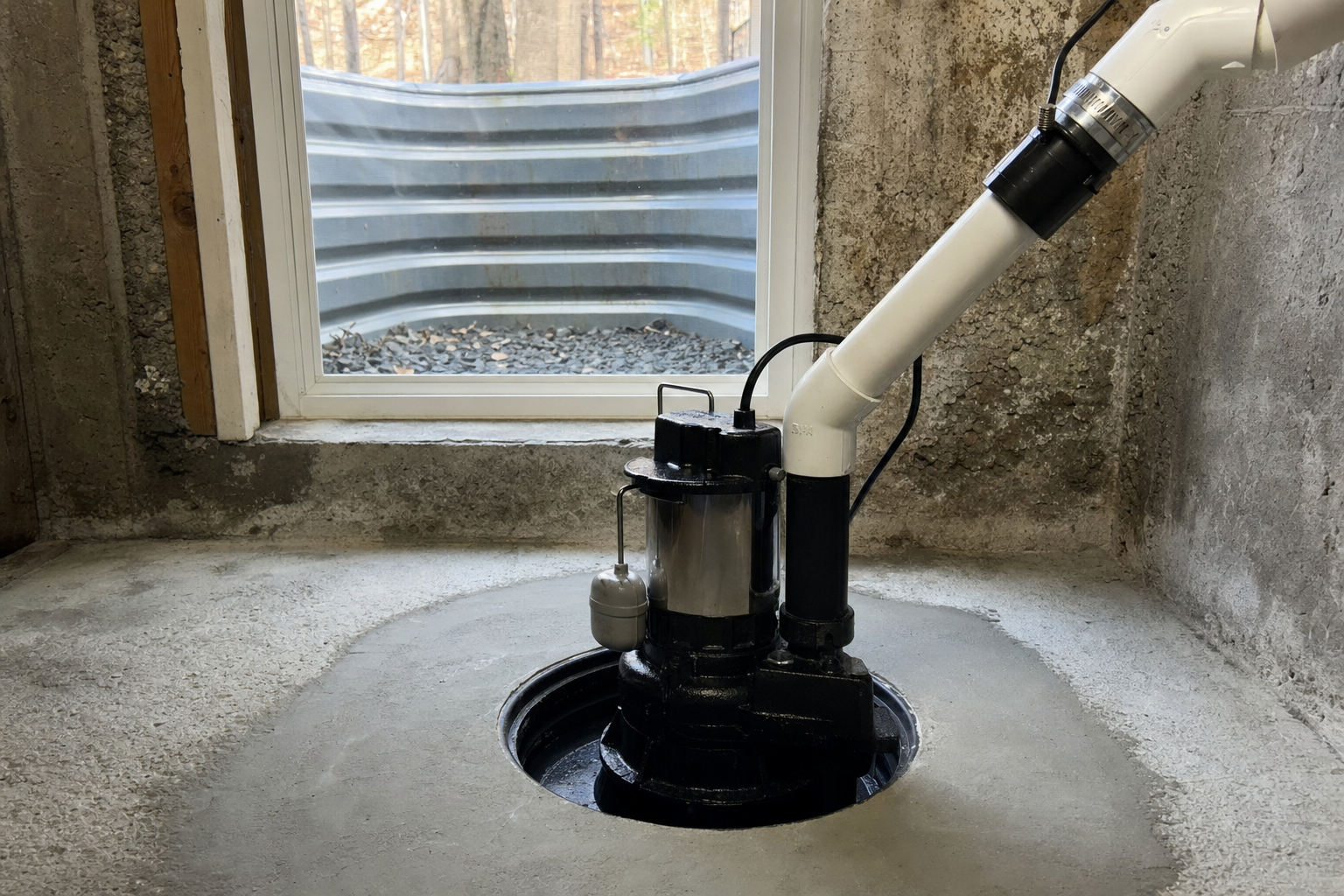 Illustrative example · representative of typical sump pump installation work · not a specific Big Easy customer project
[Problem solved – e.g. “Battery-backed pump kicked on during October power outage, basement stayed bone-dry through the storm”]
Illustrative example · representative of typical sump pump installation work · not a specific Big Easy customer project
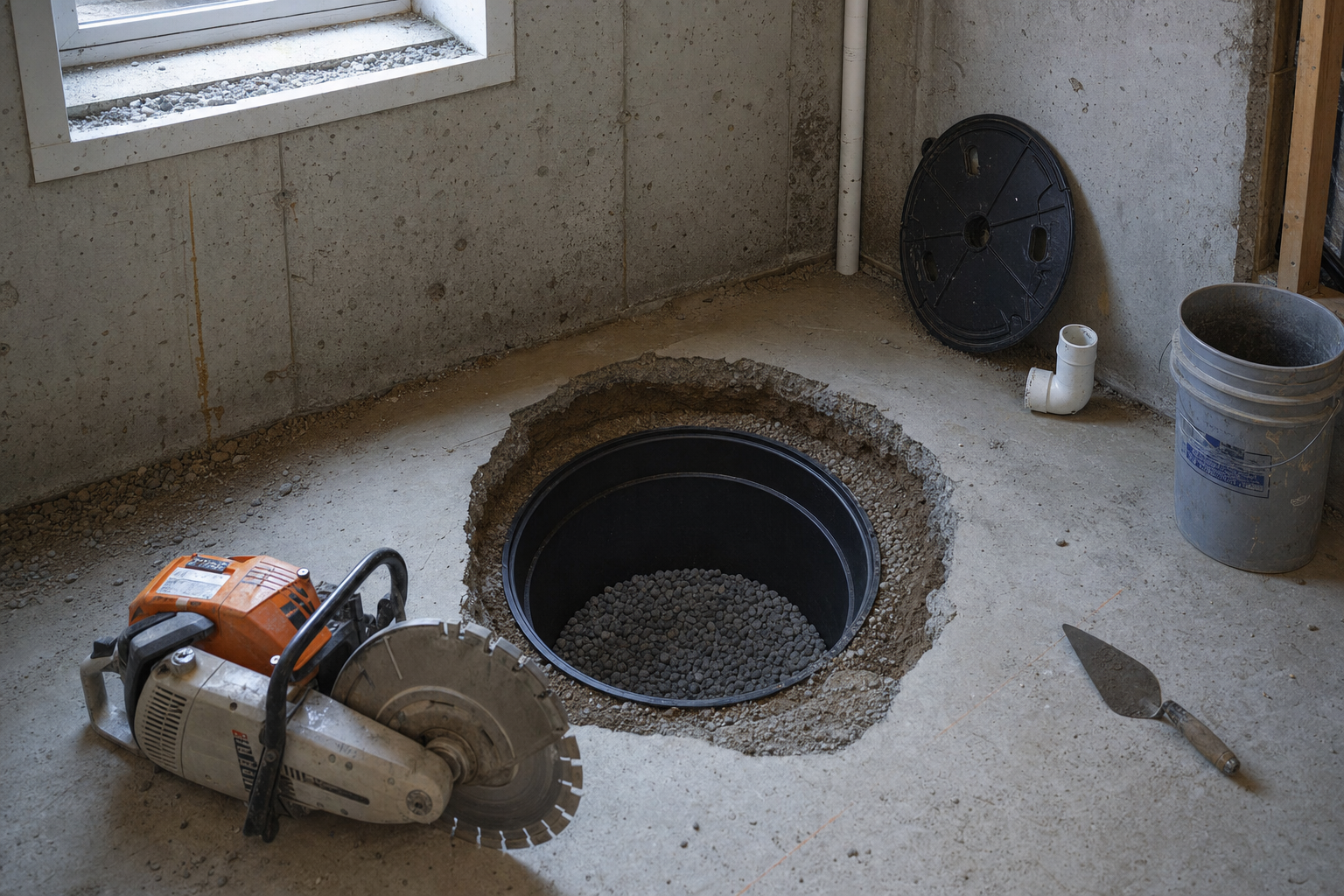 Illustrative example · representative of typical sump pump installation work · not a specific Big Easy customer project
[Problem solved – e.g. “Frozen discharge line fixed before winter, ice-damming flood prevented”]
Illustrative example · representative of typical sump pump installation work · not a specific Big Easy customer project
Frequently asked in Poughkeepsie
Sump Pump Installation-specific questions from Poughkeepsie homeowners.
Is a battery-backup sump pump necessary in Poughkeepsie?
In our judgment yes. The Mid-Hudson nor’easters and tropical remnants that produce the heaviest basement flooding in Poughkeepsie are exactly the storms that knock out grid power. Hurricane Irene (2011) and Sandy (2012) were clear examples. A primary-only pump stops the moment the power does. Battery backup is the spec we recommend on every Poughkeepsie install.
Where does the discharge line go?
Outside the foundation, below the New York State Residential Code 42-inch frost depth so it cannot freeze shut in a Mid-Hudson winter, then daylighting onto grade at a point where it carries away from the foundation. On sloped lots in the Town of Poughkeepsie or upland College Hill the discharge geometry is straightforward. On waterfront blocks near Waryas Park, the downtown waterfront, or the Northside river-edge we are more careful about where the line terminates so it does not contribute to FEMA AE-zone street-level pooling.
How loud is a modern sump pump?
A modern cast-iron primary pump runs quietly when it is properly seated in a sealed pit. Most homeowners only notice the pump cycling during heavy events. The alarm-to-phone water-level sensor we include is loud enough to wake the household – that is by design, since the cost of missing a failure during a Mid-Hudson Hudson-watershed storm event is high.
Does Poughkeepsie require a permit for a sump-pump install?
Permit requirements vary by scope and jurisdiction. New pit installations involving concrete cutting and discharge-line penetration typically require a City of Poughkeepsie or Dutchess County Building Department permit. Replacement of an existing pump in an existing pit usually does not. We pull the permits we need and handle the inspection scheduling on the homeowner’s behalf.
Get your Poughkeepsie sump-pump estimate. Free pit + discharge inspection.
About an hour on site checking existing pump condition, discharge-line frost compliance, and battery-backup readiness. No verbal guesses. Written estimate within 24 hours, with primary + battery-backup spec engineered for Mid-Hudson watershed flow.
- Live test of existing pump under simulated load
- Basin and discharge inspection
- Water-volume assessment matched to pump capacity
- Written estimate emailed within 24 hours
- Honest ‘wait two more years’ if your existing system is healthy
Book your free inspection
No obligation. Written estimate within 24 hours.
Tell us what is happening with your basement and we will email a written estimate within 24 hours. No cost, no obligation, no high-pressure follow-up.
Get a Free InspectionMore from Big Easy